
Two dates for the same deadline
On 7 November 2025 China's Ministry of Commerce and its customs administration published a one-line notice, Announcement No. 70: six export measures, signed a month earlier, were suspended "until 10 November 2026".1 They made up the package of 9 October 2025. It added five rare earths to the list of controlled materials, put the machinery and technology used to process them under licence and, for the first time, claimed to apply beyond China's borders: a foreign company would have needed Beijing's permission to export a magnet containing as little as 0.1% Chinese rare earths.2 The suspension followed the meeting between Donald Trump and Xi Jinping in South Korea at the end of October 2025.
Now the deadline has two dates. On 23 September, as Xi arrived in Washington for a state visit, US Treasury Secretary Scott Bessent told Fox News that the truce would be extended to 10 January.3 On 28 September the Chinese ministry wrote that the two sides would keep talking "on the basis" of an extension to 10 January 2027, and that it hoped to reach a further extension before the end of the year.4 As of 19 October, though, the text of Announcement No. 70 on the ministry's website still carries the date of 10 November.1
On 15 October the ministry's spokesman, He Yadong, told CNBC that China would keep approving licences for Europe whatever happens in its negotiations with the United States. A week earlier the EU trade commissioner, Maroš Šefčovič, had met the commerce minister, Wang Wentao, in Beijing.5
For anyone manufacturing in Europe, then, 10 November matters less than it seems. The part of the crackdown that has already stopped production lines was never suspended. Since 4 April 2025 seven medium and heavy rare earths (samarium, gadolinium, terbium, dysprosium, lutetium, scandium and yttrium), along with neodymium magnets containing terbium or dysprosium, leave China only with a licence, one shipment at a time.6
The magnet we do not see
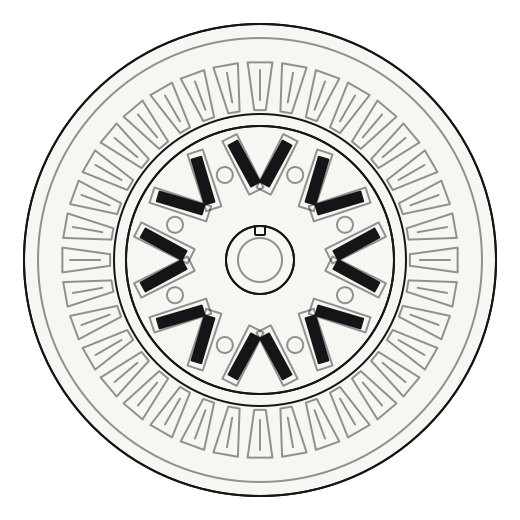
Rare earths are 17 elements: the 15 lanthanides plus scandium and yttrium.7 Four matter more than the rest, because they go into neodymium-iron-boron permanent magnets. Neodymium and praseodymium give the magnet its strength, while dysprosium and terbium stop it losing that strength when the motor heats up.7
They are the most powerful magnets industry can make in volume, and they are all around us without our seeing them. In an electric car they sit mainly in the motor: a survey of about twenty models found an average of 1.5 kilos of magnets per vehicle, with a maximum of 4 and some models using none at all.8 In a phone they are tiny. Apple says magnets are by far the largest use of rare earths in its products and gives the Taptic Engine, the small motor that makes the iPhone vibrate, as an example.9 Then there are wind turbines, industrial motors, data centres and defence systems.
What turns rare earths into a weapon is the mismatch between what they are worth and how much they are needed. According to the International Energy Agency, rare earths account for about 40% of the price of a magnet, 5% of an electric motor, less than 1% of an electric car and less than 0.1% of a petrol car.10 Roberto Vavassori, chairman of ANFIA, the Italian automotive supply chain association, put it another way in October 2025: an industry worth less than 5 billion dollars worldwide can slow down the entire car industry.11
April 2025, the dress rehearsal
The April controls took effect on the day they were announced, and within weeks suppliers' stocks were running thin. On 4 June 2025 CLEPA, the European association of automotive suppliers, said that several production lines had stopped for lack of rare earths. Of the hundreds of licence applications filed since early April, only a quarter had been approved, and more plants risked stopping within three to four weeks.12 In October Vavassori warned that the cushion of stocks companies had used to get through earlier restrictions was gone.11
The bill also shows up in prices. The IEA finds that in Europe dysprosium and terbium cost about five times as much as on China's domestic market, and attributes the gap to the controls.10 It also calculates what would happen if the October 2025 package came back in full: outside China, production worth 6.5 trillion dollars a year would be at risk, about 7% of the GDP of the countries concerned, with more than 1.5 trillion each for the United States and Europe.10
Deng's oil
"The Middle East has oil, China has rare earths." Deng Xiaoping said it in January 1992, during the tour of the country's south with which he relaunched economic reform, and today the line is carved in calligraphy in an industrial park in Baotou, Inner Mongolia.13 In the West it is quoted as proof of a thirty-year plan. The geographer Julie Klinger, who has studied Chinese newspapers and documents from those years, considers this reading ahistorical: in 1992 the Middle East meant the Gulf War that had just ended, and the line only reached Western newspapers in 2009.13
I think she is right, and that the real story is less romantic and more uncomfortable. In 2005 China produced about half of the world's sintered magnets; in 2024, 94%.7 Over those twenty years Europe, the United States and Japan let go of a dirty, low-margin business, because buying was more convenient than making.
Every innovation has a hidden price.
Third law of innovation, from Un perché alla volta (translated)
There is also a precedent with something to teach. When China limited exports with quotas and duties, the United States, the European Union and Japan took the case to the World Trade Organization and won: the rulings were adopted in August 2014 and in May 2015 Beijing reported that it had removed the quotas and duties.14 The case was won, but the refineries stayed in China. Ten years on, the tool has changed, a licence instead of a quota, and the dependence is the same.
From Deng's line to the deadline
- Jan 1992Deng Xiaoping compares rare earths to Middle Eastern oil
- Aug 2014The WTO rules against China's export quotas and duties
- Apr 2025Licences required for seven medium and heavy rare earths
- Jun 2025European car suppliers halt the first lines
- Oct 2025The second package, with the 0.1% rule
- Nov 2025The second package is suspended until 10 November 2026
- Sep 2026Washington and Beijing talk of an extension to 10 January 2027
The United States, Europe and Italy
The United States has chosen to put public money on the price. On 10 July 2025 the Pentagon bought 400 million dollars of preferred shares in MP Materials, guaranteed a ten-year minimum price of 110 dollars a kilo for neodymium-praseodymium products, and committed to having every magnet from the new factory bought. The plant is due to start up in 2028 and bring the company's US capacity to about 10,000 tonnes.15 In February 2026 came Project Vault, a strategic reserve of critical minerals backed by up to 12 billion dollars with rare earths among its priorities.10
Europe has chosen targets. The Critical Raw Materials Act, in force since 23 May 2024, requires that by 2030 the Union extract 10%, process 40% and recycle 25% of its annual consumption of strategic raw materials, and that it depend on no single third country for more than 65% of any of them.16 The starting point is a long way off: the Union buys all its heavy rare earths, 85% of its light ones and 98% of its magnets from China.2 On 9 October the Commission picked 46 new strategic projects, four of them on rare earths for magnets, and says that together with the 2025 projects they could fully meet the extraction, processing and recycling targets for rare earths.17
The missing step is the last one. Europe's targets measure the mining, processing and recycling of the raw material, not the making of magnets, and the IEA shows that this is exactly where the bottleneck is. Today about 15% of the magnets the rest of the world needs are made outside China, and even counting the new capacity expected, more than 80% would still be missing in 2035.10
How much of the need non-Chinese producers cover today
Italy is moving under Decree-Law 84 of 2024 on critical raw materials. ISPRA's national exploration programme lists areas to study for rare earths, mostly in Sardinia, in the south of the island and the Funtana Raminosa district, and then in the Southern Alps, Lazio and Campania.18 For now this is exploration, and it will take years to know whether anything is worth mining. The most concrete project is about recycling. In Ceccano, in the province of Frosinone, Itelyum leads INSPIREE, one of the 47 European strategic projects of 2025, which recovers neodymium, praseodymium and dysprosium from used magnets. The pilot phase processed about 20 tonnes of magnets a year and the Commission puts the plant's capacity at 170 tonnes of rare earths a year.19
What I think
This dependence cannot be fixed by decree, nor by the date of a summit. At best, the truce moves the deadline by two months. A refinery or a magnet factory takes years: the American deal signed in 2025 will deliver magnets from 2028. It is the same pattern as the technological dependence I wrote about for the cloud and artificial intelligence, with one serious difference: a software supplier can be replaced in a few months, a chemical and metallurgical chain cannot.
Two things seem clear to me. The first is that Europe should set itself an explicit target for magnets, because that is where the distance from China is greatest, and projects on mines and oxides do little good if the oxides then go to Asia to become magnets. The second is that paying more to buy elsewhere costs less than people think. The IEA calculates that tripling the price of rare earths would raise the cost of a car by 0.1%, and calls it a security premium, a form of insurance.10 Companies that choose their magnet supplier on price alone are giving up that insurance.
What companies can do
According to a European Central Bank estimate, more than 80% of large European companies are no more than three steps away from a Chinese rare earth producer, and companies had generally not built up stocks.2 This is where I would start.
- InventoryKnow where the magnets areList the components with neodymium magnets, trace the suppliers' suppliers and find out which parts depend on the seven rare earths under licence.
- StocksBuy timeThe IEA estimates that stockpiling 11 at-risk materials would cost all countries outside China less than 900 million dollars a year, little compared with the damage of a blockage.
- DesignMake magnets recoverableToday recycling lives almost entirely on production scrap. A magnet glued inside a component is hard to extract: designing for disassembly and marking where the magnets are makes it possible. Apple has reached 99% recycled rare earths in its magnets.
- AlternativesTry motors without rare earthsThere are motors without permanent magnets and magnets without rare earths, such as Niron's iron nitride magnets, whose Minnesota factory starts up in 2027 and at full capacity can make up to 1,500 tonnes a year.
According to the IEA, recycling today recovers little from end-of-life products, but the first retired electric cars and wind turbines will bring growing quantities of magnets to recover.10 Apple shows that recycling works when whoever designs the product also controls it.9 Niron, which in September raised the first steel beams of its Sartell factory and counts Honda among its investors, shows that alternatives exist, though still on a small scale.20
The signal to watch over the next two weeks is a single one: a new notice from China's Ministry of Commerce replacing the date in Announcement No. 70. If it comes, the deadline becomes 10 January 2027. If it does not, from 11 November the October 2025 package, including the 0.1% rule, would formally come back into force. Either way, the April 2025 licences stay where they are.