
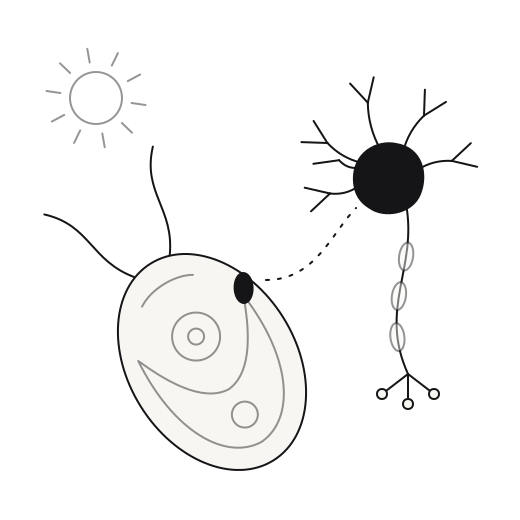
An alga that swims towards light
On 5 October the Nobel Assembly at Karolinska Institutet awarded the 2026 Nobel Prize in Physiology or Medicine to Karl Deisseroth, of Stanford University and the Howard Hughes Medical Institute, Peter Hegemann, of Humboldt University of Berlin, and Georg Nagel, of the University of Würzburg. The citation refers to light-gated ion channels and optogenetics, the method that makes it possible to switch specific groups of neurons on and off with light in a living brain. The three will share 12 million Swedish kronor.1
The story begins with Chlamydomonas reinhardtii, a green alga made of a single cell. Stir these algae into a dish of water, light up one side, and the green drifts towards the light: the algae swim towards it, guided by a tiny orange spot on the surface of the cell.2
In the early 1990s Peter Hegemann, at the Max Planck Institute of Biochemistry in Martinsried, near Munich, wondered how the alga could react so quickly. Using tiny electrodes he measured its electrical signals and found that the impulse started half a millisecond after the light arrived. In our own eyes the same step takes a chain of chemical reactions and at least 10 milliseconds, more than twenty times as long. Hegemann concluded that in the alga a single protein must do the whole job: capture the light and open a channel for ions. At the time nobody knew of any channel that could respond to light on its own, and the idea was met with scepticism.2
Proving it took almost ten years, because the proteins of the alga's eyespot fell apart once removed from the cell. Around 2000 a Japanese group published the sequences of thousands of Chlamydomonas genes, and Hegemann found two that resembled those of light-capturing proteins. He sent them to Georg Nagel, at the Max Planck Institute of Biophysics in Frankfurt, who knew how to make frog eggs produce foreign proteins. In 2002, in Science, they described the first, channelrhodopsin-1. In 2003, in PNAS, the second, channelrhodopsin-2: lit with blue light it opens in 0.2 milliseconds, and placed in human kidney cells it makes them light-sensitive. In that paper they already suggested using it as a tool to generate electrical impulses in cells.2
From the dish to a mouse's brain
Karl Deisseroth came from a different direction. He studied medicine at Stanford and was thinking of neurosurgery, but during his training in psychiatry he was struck by how much the patients suffered and how little the available treatments helped them. In the lab he worked on thin slices of brain in a dish, and realised that to study depression or schizophrenia he would need to act on specific neurons in a living brain. Francis Crick, of double-helix fame, had described the idea years earlier: use light, which is fast enough to keep pace with the signals of neurons.2
When he set up his own lab, Deisseroth wrote to Nagel and asked for the DNA of channelrhodopsin-2. He put it into rat neurons grown in a dish, lit them with blue light and got nerve impulses precise to the millisecond. The work appeared in Nature Neuroscience in 2005. In 2006 the method was named optogenetics, and in 2007 Deisseroth's group took it into the brains of living mice: a thin optical fibre went in through a small hole in the skull and, when the light came on, the animal moved its whiskers. The same year, with other colleagues, Deisseroth woke sleeping mice on demand by activating a type of neuron suspected of controlling wakefulness.2
In 2012, in Susumu Tonegawa's lab, researchers tagged the neurons that were active while a mouse learned to fear a particular place. When those neurons were switched back on with light in a calm setting, the mouse froze as if it were in danger again. It was the first time anyone had identified the cells needed for a specific memory.3 The same method has been used to separate the circuits of reward from those of aversion and anxiety from fear, and to show that in mice gathering the young into the nest and grooming them depend on different circuits. The committee lists depression, anxiety, schizophrenia, Alzheimer's and Parkinson's among the diseases now better understood thanks to optogenetics.2
- Early 1990sThe questionHegemann wonders how Chlamydomonas reacts to light in half a millisecond and suggests that a single protein does everything.
- 2002-2003The proteinNagel and Hegemann describe channelrhodopsin-1 in Science and channelrhodopsin-2 in PNAS.
- 2005-2007The neuronDeisseroth's group switches on neurons in a dish with blue light, then in the brains of living mice.
- 2021The patientA man blinded by retinitis pigmentosa perceives, counts and touches objects on a table after optogenetic therapy.
Who is left out of the picture
The 2005 paper has five names on it. The first is Ed Boyden, then a PhD student at Stanford and now at MIT. The second is Feng Zhang, one of Deisseroth's first students. Then come Ernst Bamberg, Nagel's PhD supervisor, who also signed the 2002 and 2003 papers, Nagel and finally Deisseroth.2 In 2002, before channelrhodopsin, Gero Miesenböck's group had already made some neurons light-sensitive, with a slower and less precise three-protein system.3 And Zhuo-Hua Pan, at Wayne State University, had tested channelrhodopsin in the retina as early as 2004, but his paper did not come out until 2006.4
The statutes of the Nobel Foundation say that a prize may not be divided between more than three people.5 After the announcement, several researchers wrote on social media that Boyden should not have been left out. He did not respond to requests for comment.4 And each prize has drawn up its own list.
Who has been honoured for optogenetics
| Prize | Year | Laureates |
|---|---|---|
| Brain Prize | 2013 | Bamberg, Boyden, Deisseroth, Hegemann, Miesenböck, Nagel |
| Lasker Basic Medical Research Award | 2021 | Oesterhelt, Hegemann, Deisseroth |
| Nobel Prize in Physiology or Medicine | 2026 | Deisseroth, Hegemann, Nagel |
The 2013 Brain Prize split one million euros among six researchers.6 The 2021 Lasker Award included Dieter Oesterhelt, Hegemann's PhD supervisor, and not Nagel.7 In 1971 Oesterhelt had discovered bacteriorhodopsin, a light-driven pump in a microbe that lives in very salty water: the first sign that a single protein could move ions using light.3
None of this takes anything away from the three laureates. I have written about the hands history forgets, and here you can see them one after another in the bylines of a paper. The rule of three says a lot about the prize and little about how the research actually went.
From mouse to human
In May 2021 Nature Medicine published the first case of partial recovery of sight through optogenetics. The patient was a man blinded by retinitis pigmentosa, an inherited disease that destroys the rods and cones. The team led by José-Alain Sahel and Botond Roska, working with the French company GenSight Biologics, injected into his eye a modified virus carrying the gene for ChrimsonR, a relative of channelrhodopsin that responds to redder light. The retinal cells that had survived the disease became light-sensitive. With special goggles, which turn changes in brightness into pulses of light projected onto the retina, the man perceived, located, counted and touched objects on a table using only the treated eye. Before, with or without the goggles, he could see none of them.8
It is a single case and the sight recovered is partial. According to the Nobel committee several clinical trials for retinitis pigmentosa are under way, and optogenetics is also being studied for cochlear implants more precise than today's electrical ones.2 For now it is mainly a laboratory tool. Deisseroth calls it an engine for discovery, a way of probing complex systems at the level of individual cells.9
No Nobel for artificial intelligence in 2026
In 2024 the physics and chemistry prizes both went to work linked to artificial intelligence. Physics to John Hopfield and Geoffrey Hinton for artificial neural networks.10 Chemistry to Demis Hassabis and John Jumper for AlphaFold, which predicts the shape of proteins, and to David Baker for computational protein design.11
In 2026 no prize went to AI. Physics went to Francis Halzen for the IceCube neutrino observatory, chemistry to Henri Kagan and Kenso Soai for non-linear effects and autocatalysis in asymmetric organic synthesis, medicine to optogenetics.12
The contrast with 2024 is a reminder of where AI comes from. Hopfield's network dates from 1982, Hinton's Boltzmann machine from 1985, and the 2024 committee writes that the inspiration for artificial neural networks came from the wish to understand how the brain works.10 AlphaFold was trained on the databases of all known protein structures, worked out one by one in laboratories, many of them with X-ray crystallography.11 The AI that now speeds up research, as I wrote about the biotech company made of agents, runs on data that curiosity produced first. And optogenetics gives neuroscientists a tool to answer the very questions about the brain that neural networks started from.
Why we should fund questions with no purpose
Every innovation begins with a question.
First law of innovation, from Un perché alla volta (translated)
The story of this Nobel follows it to the letter. In the early 1990s nobody could have written in a grant application that studying an alga's eyespot would help explain fear in mice or give a blind man a little of his sight back. The prize-winning discoveries were made at two Max Planck institutes, and the DFG, Germany's research funding agency, notes that it funded the basic research on channelrhodopsins and their development into tools.13
In the United States this kind of research is under pressure. For 2026 the White House proposed cutting the budget of the National Institutes of Health by 41%. Congress kept the funding, but by July, three quarters of the way through the fiscal year, the agency had committed only about half of it, and grant renewals more than 90 days late have been four to six times more frequent than in the years 2021 to 2024.14 For 2027 the proposal is to give the National Science Foundation 4 billion dollars, 54% less, with 2,100 research grants against 5,800 in 2025.15 These are proposals, and Congress has the final say.
In Italy the problem is older. According to Eurostat estimates, in 2024 Italy spent 1.41% of GDP on research and development, against an EU average of 2.26% and 3.12% in Germany.16
Spending on research and development in 2024, as a share of GDP
There is no shortage of good Italian researchers. In the 2026 round of the European Research Council's Starting Grants, worth up to 1.5 million euros over five years for researchers early in their careers, 50 winners are Italian, second only to Germans.17 But only 22 of the projects are hosted in Italy, so at least 28 Italians will take their funding to another country.18
I think this is the lesson of the 2026 Nobel. An agency that funds only projects with an application already written down would have turned Hegemann away, and it would have had its reasons: for ten years his hypothesis remained unproven and the proteins kept falling apart in the test tube. Basic research pays off late and in places nobody can predict, so it has to be funded on its own terms: open calls, long timeframes, and assessment based on the quality of the question rather than the promise of a product. For a country that spends as little as Italy does, it is also how to avoid having to buy from others, twenty years from now, the tools born of questions it never asked, along with the dependence that follows.
On 10 December Deisseroth, Hegemann and Nagel will receive their prize in Stockholm. It will be exactly 125 years since the first Nobel Prizes were presented, on 10 December 1901. The date was the anniversary of Alfred Nobel's death, in Sanremo five years earlier, on 10 December 1896.19