
The laws of innovation
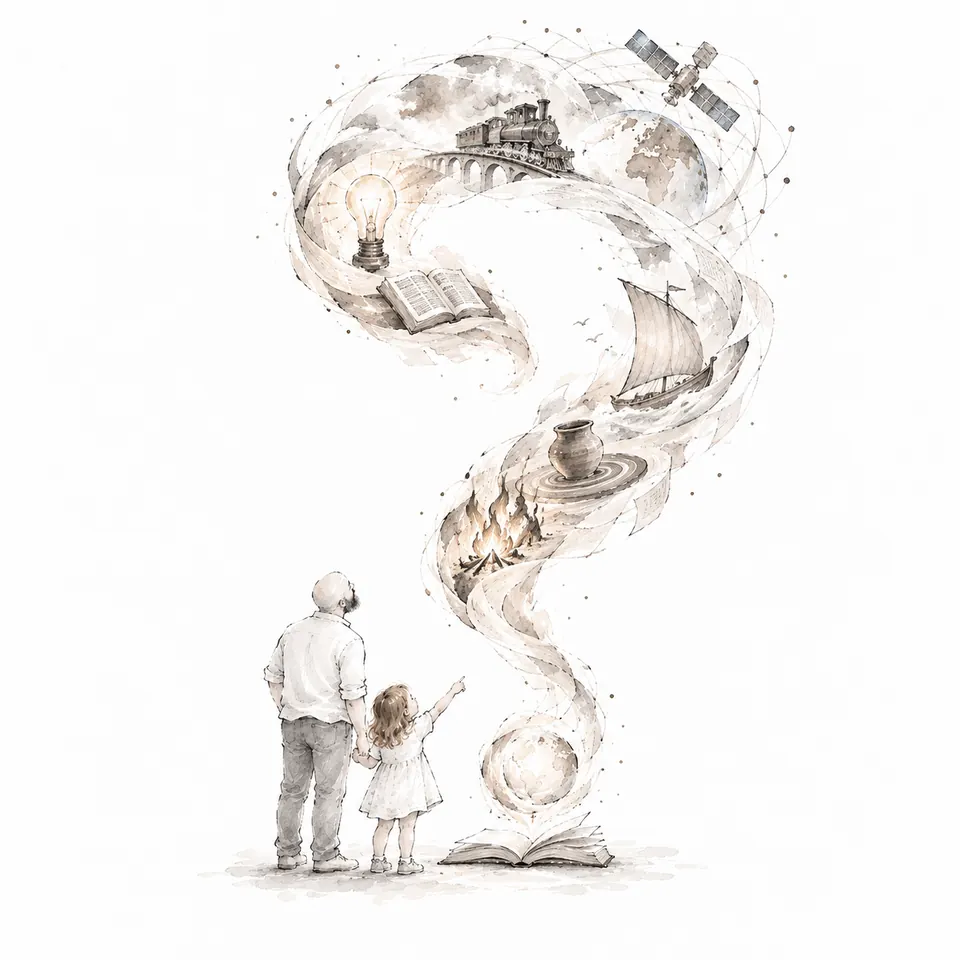
Thirteen regularities that recur in every great invention, from fire to artificial intelligence. I wrote them at the end of the prologue and of each chapter of “Un perché alla volta”, and I use them every day to read what is happening with AI.
How to use them
They do not predict the future. They help us look at it with less naive eyes.
They are not laws in the sense of physics: none of them holds always and without exception. They are regularities, things that have happened so many times they have become almost predictable. When a new technology arrives, artificial intelligence included, I ask myself which of these laws are at work: usually more than one.
The laws of innovation (translated from the Italian)
- Every innovation begins with a question. Whoever stops asking “why?” also stops inventing.From the prologue “Why?”
- Nothing is invented from nothing: we tame what already exists. The greatest innovations come from learning to use a force that was already there, like fire, wind, wheat, the wolf.From the chapter “Why does it get dark?”
- Every innovation has a hidden price. Often it is paid by someone who did not choose, and often, once it has begun, there is no turning back.From the chapter “Where does food come from?”
- Brilliant ideas look obvious only afterwards. Innovation is often not discovering something new, but combining two old things in a way that can become useful and widespread, like the wheel and the suitcase.From the chapter “Why is the wheel round?”
- Innovation begins where comfort ends. To find out what lies on the other side, someone has to accept leaving the shore.From the chapter “Can you go to the other side of the sea?”
- No invention stays what it was born for. The first Mesopotamian writing recorded goods and accounts, ARPANET connected a few research computers, text messages became far more popular than many expected.From the chapter “What does it say?”
- When copying is cheap, the world changes. And the problem is no longer finding information, but choosing which to trust.From the chapter “Who made the books?”
- Nobody invents alone. Behind every famous name there are many hands, many ideas and many attempts that history forgets.From the chapter “Why does the light come on?”
- The best technology brings distant people closer. But if we are not careful, the same technology can push away those who are close.From the chapter “Can I talk to Grandma?”
- The best protections can go unnoticed: when they work, they prevent the worst from happening. Some even help us become able to do without them.From the chapter “Why do I have to wear the life jacket?”
- Every machine also changes the person who uses it. How a technology transforms people’s lives does not depend only on the technology, but on the choices we make about how to use it.From the chapter “Who makes the machines go?”
- Machines do what we say, not what we mean. There is always a gap between the two, and in that gap mistakes are born.From the chapter “Does the computer think?”
- Machines can learn from examples and help us explore questions. But every idea leaves a footprint, and the task of choosing the right questions remains ours.From the chapter “Daddy, who are you talking to?”
The laws that run through everything
Rereading the book, I noticed that some ideas come back in almost every chapter, even without a law of their own.
- The spread of an invention depends on the system that makes it useful. The wheel without draught animals, the light bulb without power stations, the Analytical Engine without the technology to build it: they show how much the surrounding conditions matter in turning an idea into widespread use.
- The best ideas travel from one field to another. The wine press became the printing press, the punched-card loom became the computer, the car’s gas regulator became the diver’s breathing valve, video-game processors became the brain of artificial intelligence.
- The inventor is not always the one who profits. Gutenberg, Meucci, Babbage, Barsanti, Semmelweis, Turing: their fortunes were very different. Some met poverty or little recognition; others, like Turing, received honours and then suffered persecution. The value of their work did not protect them from injustice.
- Sometimes the best way to keep an idea alive is to give it away. The daguerreotype, the web, the seat belt, the polio vaccine and free software changed the world partly through choices that widened access. Public, free of charge and free as in freedom are not the same thing, though: patents and licences make these stories different.
- And above all: the future never goes the way we expect. None of the inventors in this book could foresee all the consequences of their invention. It is a reason to be humble when we make predictions. And it is also a reason to be optimistic: the future is still open, and it will be written by people who are three years old today.