
The future always arrives sooner than expected
Every great invention looked like science fiction, until we found it in our pocket. With artificial intelligence it is happening again, at a speed without precedent.
Updated October 2026
My point of view
In the short run we almost always overestimate a technology; in the long run we underestimate it. With AI, the long run has become shorter.
Twelve seconds, sixty-six years
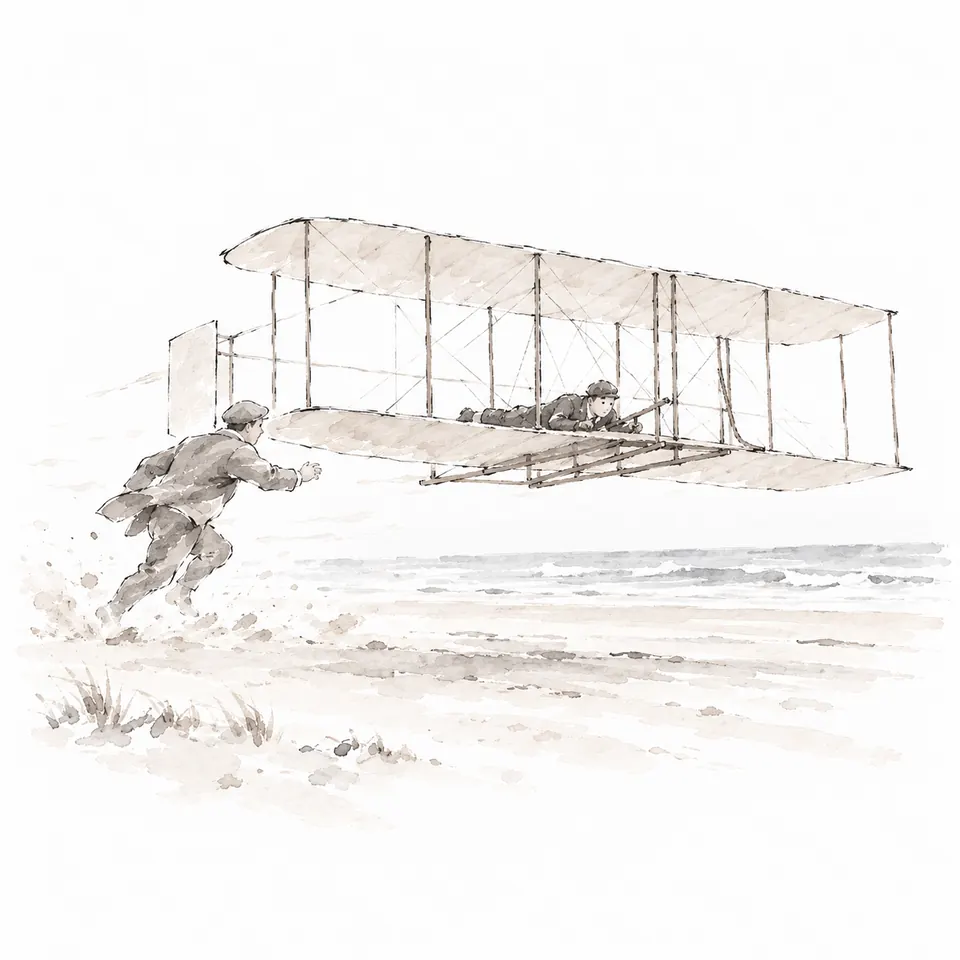
On 17 December 1903, at Kitty Hawk, the Wright brothers' Flyer stayed in the air for twelve seconds. Sixty-six years later a man walked on the Moon. A single human lifetime separates the first powered flight from the landing: a child watching that day could have seen both.
I often tell this story because it describes how the future shows up. First as a curiosity, then as news, and finally as a habit nobody notices any more.
Why we notice late
The pattern is named after the American researcher Roy Amara, and artificial intelligence is its clearest example. In 1955 the organisers of the Dartmouth workshop, which gave the field its name, expected significant progress within a single summer. Decades of broken promises followed, the “AI winters”.
Then data, computing power and algorithms matured together, and everything sped up. In 2016 AlphaGo beat Lee Sedol at Go, a milestone many experts placed at least ten years away. In November 2022 ChatGPT arrived: according to UBS estimates reported by Reuters, it reached 100 million monthly users in about two months. TikTok had taken nine months, Instagram two and a half years.
What I see from the inside
In my work I watch the same pattern every week. A tool that looks like an experiment in January is part of a company's processes by June. The gap that matters separates those who have understood the direction from those waiting for the novelty to settle. Usually, by the time it settles, others have already seized the advantage.
Noticing in time does not mean chasing every announcement. It means telling noise from signal: a technology becomes an innovation when it meets a real problem and someone who uses it. It is the formula I built my children's book on, and it holds for a company as much as for a three-year-old.
…the future is still open, and it will be written by people who are three years old today.
From Un perché alla volta (translated)
The question to ask now
What artificial intelligence can do today will change within months, so a different question is more useful: what becomes possible when what costs effort today costs almost nothing tomorrow? Those who ask early have time to rethink products, skills and organisation. Those who wait can only adapt.