
Innovation is about people
No tool works if the people using it do not understand it. Artificial intelligence changes every year: the difference is made by those who know how to put it to work.
Updated October 2026
My point of view
Technology can be bought. The ability to use it well has to be built, one person at a time.
Being right is not enough
In 1847 the Hungarian doctor Ignác Semmelweis showed that washing hands drastically cut deaths on maternity wards. He was right, and for years his colleagues ignored him. It is one of the stories I most like to tell, because it holds a principle that still applies: an innovation, even one that saves lives, has to be accepted by the people who are meant to use it.
The same happens with artificial intelligence in companies. Licences can be switched on in a day. Changing the way a group of people works takes months, trust and concrete examples. The projects I see run aground rarely stop because of technical limits. They stop because nobody explained to the people who were meant to use them what they stood to gain.
The hands history forgets
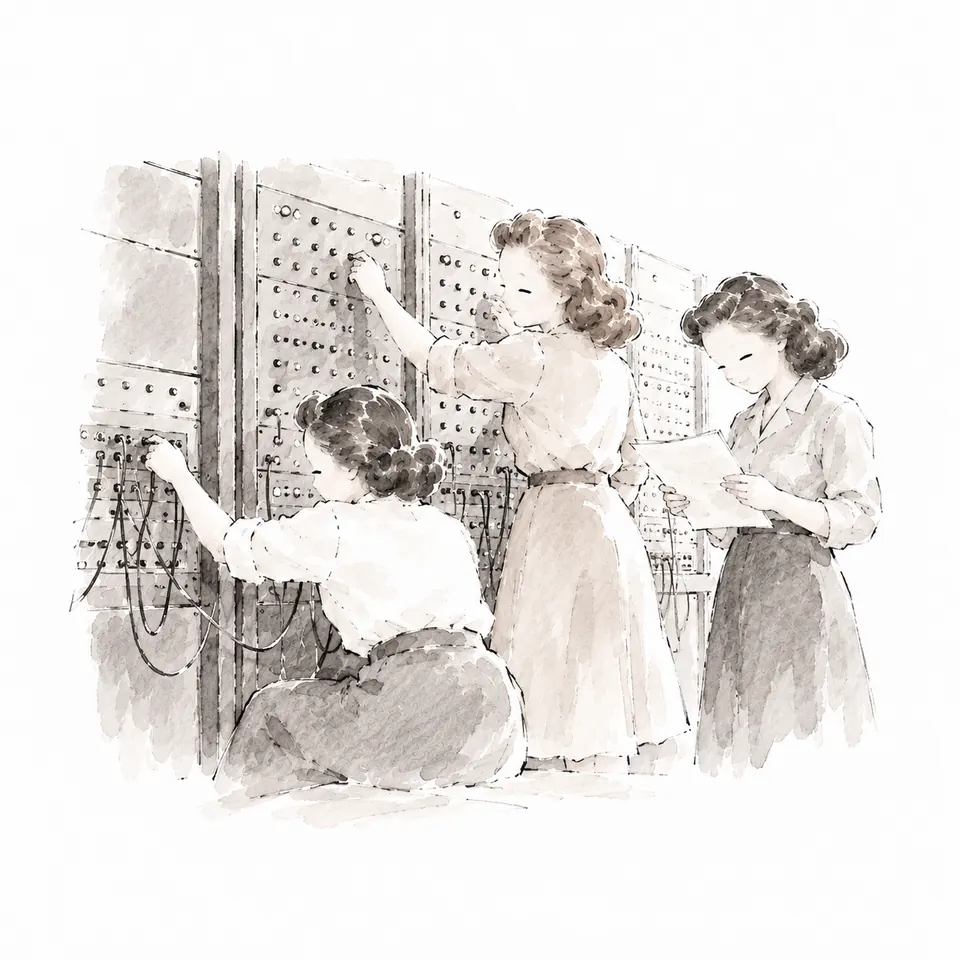
When people tell the history of the computer they mention Babbage, Turing, von Neumann. They rarely remember the six women who in 1945 programmed ENIAC, one of the first electronic computers, by connecting cables and switches without manuals, because no manuals existed yet.
Behind today's models lies an equally invisible human supply chain: millions of people who label data and moderate content, often in the Global South and with minimal protection. I write about them in AI: L'Impronta Fantasma. Every system that seems to run by itself rests on someone's work.
Engineers build the tools. But it is people, millions of ordinary people, who decide what they will become.
From Un perché alla volta (translated)
What will stay valuable
When people ask me which qualities will matter in a world full of ever more capable machines, I answer with the three I also wrote down for my daughter: curiosity, which gives rise to questions; judgement, which tells a good answer from a bad one; and the ability to work with other people and to take care of them.
For an organisation this turns into precise choices. Train everyone, not just the technical staff. Make room for those who experiment. Measure real use, not the number of licences. Show with concrete examples what changes in each person's work. It is the least spectacular part of innovation, and the one that decides whether it will work.