
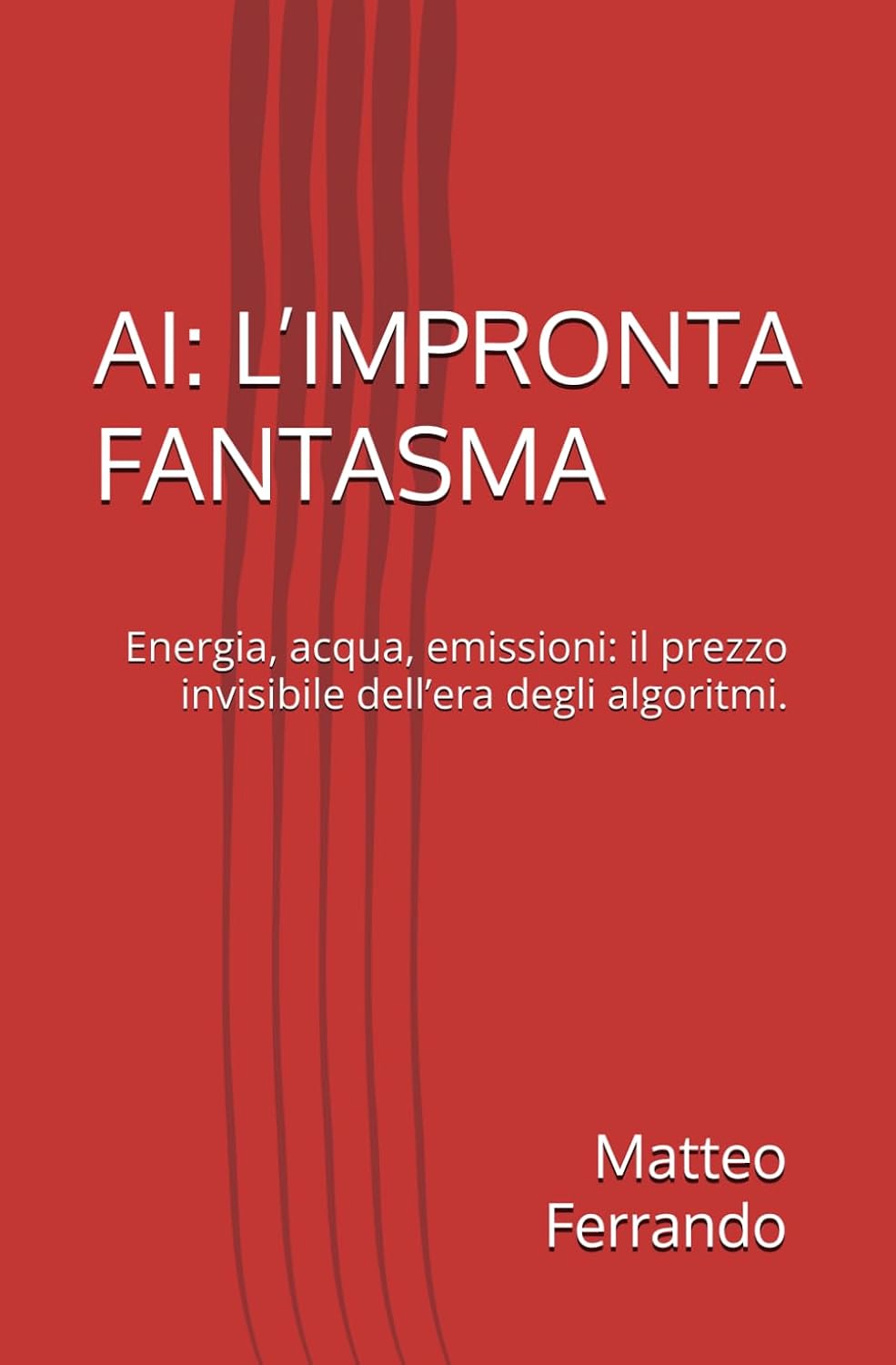
AI: L'Impronta Fantasma
Energy, water, emissions: the invisible price of the age of algorithms.
Every question to an assistant fires up processors, uses electricity, evaporates water. This essay follows the supply chain of artificial intelligence from the mine to the data centre and on to electronic waste, to make visible a cost nobody sees today and to understand how to reduce it.
Why I wrote it
I work with artificial intelligence every day, and every day I see how light we think it is: a window, a question, an answer in a few seconds. I wanted to understand what happens on the other side of the screen. I found a physical world made of power plants, cooling towers, aquifers and mines.
It is not a book against technology. It is an attempt to bring the digital world back within the planet's limits, with the numbers available and with the questions still open: who really pays this cost, and how to reduce it without giving up what AI makes possible.
Writing has a cost too. That is why the first page declares the footprint of the book itself.
Inside the book
- Chapter 1The invisible cost of artificial intelligence
Behind every prompt stands a physical giant: energy, water, metals, waste.
- Chapter 2From symbolic machines to digital gods
From Turing to Transformers, a race in which every model is bigger than the last.
- Chapter 3The power stations of the digital age
Data centres and power grids: where the energy goes and how to save it.
- Chapter 4The water hidden in algorithms
Cooling, evaporation, arid regions: the water footprint few talk about.
- Chapter 5Mines, chips and digital debris
Cobalt, lithium and rare earths, the chip supply chain, the mountain of e-waste.
- Chapter 6The CO₂ of algorithms
Training, everyday use, hardware production: where emissions really come from.
- Chapter 7Making artificial intelligence sustainable
Lighter models, efficient chips, clean energy, longer-lasting hardware: the concrete levers.
- Chapter 8When the algorithm defends the Earth
Power grids, climate, farming, oceans: AI as an ally of the environment.
- Chapter 9Governing artificial intelligence before it governs us
AI Act, Green Deal, the United States and China: the rules we have and those we lack.
- Chapter 10The planet's computational future
Scenarios to 2030 and new indicators to reconcile AI with planetary limits.
- Deep divesFive dossiers for those who want to go further
- Deep dive 1Data centres, energy, water
The factories of the digital age, measured in terawatt-hours and litres.
- Deep dive 2Raw materials, supply chains, rights
Silicon, copper, lithium, cobalt: the atoms of artificial intelligence.
- Deep dive 3Policy, governance, rules
Europe, the United States, China and the United Nations compared.
- Deep dive 4Social justice and equity
The invisible human supply chain that trains and cleans up the models.
- Deep dive 5Environmental justice
Who hosts the data centres, who pays the price, who reaps the benefits.
The digital revolution has radically transformed the way we live, work and communicate. In a few years, what was once confined to laboratories and scientific journals has become an everyday presence: artificial intelligence today writes texts, generates images, optimises industrial processes, recommends our purchases, drives cars, works alongside doctors and teachers.
It has become the invisible engine of our hyperconnected society.
And yet, behind the apparent lightness of a typed prompt and an answer that appears in a few seconds, lies a physical giant: a colossal infrastructure, energy-hungry and thirsty for water, dependent on mines, rare metals and global supply chains. Artificial intelligence is not ethereal: it has weight, it gives off heat, it consumes. It has a real ecological footprint, often invisible to those who use it. That footprint is what I want to make visible.
From chapter 1, “The invisible cost of artificial intelligence”, translated from the Italian
The numbers to start from
Figures updated from the original sources. The invisible weight of artificial intelligence →
Three lines from the book (translated)
- “Digital, which for years we considered “clean”, thus reveals its physical side: noisy, hot, water-hungry.”
- “Before an algorithm comes to life there is a long journey that begins in the mines.”
- “Because AI is not just a technology. It is a collective choice about the future we are building.”
Who it is for
For people who use artificial intelligence every day and want to know what lies behind it. For those who bring it into companies, schools and institutions and have to decide how to use it wisely. No technical background is needed: curiosity and a little patience with numbers are enough.