
A biotech with no staff
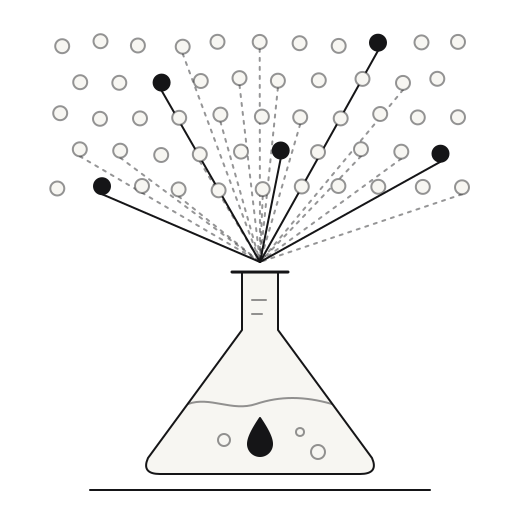
On 17 September Stanford Medicine presented a biotech company with 37,000 employees, none of them human.1 It is called the Virtual Biotech and was described the same day in Science by Harrison Zhang, a graduate student, and James Zou, a professor of biomedical data science.2 It is a research project organised like a company: one agent acts as chief scientific officer, passes questions to specialist divisions (target discovery, safety, choice of drug type, clinical development) and puts the answers together.
The first experiment is the one that made the news: more than 37,000 agents read the results of 55,984 registered clinical trials, one trial per agent, and pulled out efficacy and side effects in a structured form. In the preprint the authors report that 37,075 phase 2 and 3 trials were processed in 6 hours, whereas a single agent would have needed about 1,839 hours, more than 76 days.3 The agents ran on Claude Sonnet 4.5, Anthropic's model.
They then cross-referenced them with maps of gene activity in individual cells. For each drug's target they measured two things: whether the gene is active in just one cell type or a bit everywhere, and whether it behaves like a switch, on or off, or like a volume knob. Drugs that hit genes of the first kind, specific and switch-like, did better.
Zou explains it like this: a target that switches on in a single cell type is easier to control, and the drug does less harm elsewhere. The authors, though, write that their analyses are observational, and that the disease, the way each trial defines success and the sponsor can all play a part.3 It is a correlation found in the records. Showing an effect needs drugs designed on that basis and put to the test.
Why a good target is worth so much
About 90% of candidates that enter clinical trials never get approved. An analysis of data from 2010 to 2017 puts 40-50% of these failures down to insufficient efficacy and 30% to toxicity that cannot be managed.4 In most cases, then, the drug works too little or does too much harm, and both depend heavily on the choice of target.
Every failure has a price, and estimates of what a new drug costs vary a lot. The Tufts Center for the Study of Drug Development, using confidential data from ten companies, reached 2.6 billion dollars per approved drug, also counting the return lost on capital tied up for years.5 A study in JAMA, using only public data on 63 drugs, gave a median of 985 million.6
What it costs to bring a new drug to market
There is already an early tally for drugs discovered with artificial intelligence. In 2024 researchers at Boston Consulting Group followed the molecules of biotech companies built around AI: 80-90% get through phase 1, far more than the historical average. In phase 2, where you start to see whether the drug works in patients, the share falls to about 40%, similar to conventional drugs.7 The sample is small. AI can already design well-made, well-tolerated molecules. The most expensive risk, that the drug does too little, it has not reduced so far.
The lung cancer case, read closely
The second test produced the boldest headlines. The agents were asked to assess B7-H3, a protein studied for years in lung cancer, with no web access and a model whose knowledge stopped in January 2025.3 They noticed that B7-H3 is abundant in fibroblasts, connective tissue cells near the tumour, and that those fibroblasts seem to keep immune defences away. They proposed an antibody-drug conjugate, an antibody that binds to cells rich in B7-H3 and delivers a chemotherapy drug to them. The analysis took less than a day and 46 dollars in computing costs.
On 18 August 2025 the FDA granted Breakthrough Therapy designation, which speeds up promising drugs, to ifinatamab deruxtecan from Daiichi Sankyo and Merck: an antibody-drug conjugate against B7-H3, for small cell lung cancer.8 The model could not have known, and both the study and Stanford's press release present this as independent confirmation.
Look at the dates and the prediction is less impressive. On 20 August 2024, before the model's knowledge cutoff, GSK had already received the same designation for another antibody-drug conjugate against B7-H3, also in small cell lung cancer.9 The authors acknowledge this: they write that the literature had already prompted antibody and conjugate programmes, and that the new part is the role of fibroblasts. That, however, is a hypothesis nobody has yet tested in a lab. Zou is the first to say so: the next step is to take these findings into real labs and count how many hold up.1
Where AI has already passed a test
The strongest case of AI passing an outside test is AlphaFold. In 2024 half of the Nobel Prize in Chemistry went to Demis Hassabis and John Jumper of Google DeepMind, whose model predicted the structure of almost all of the 200 million known proteins, and the other half to David Baker, for designing new proteins.10
Zou's own "Virtual Lab", published in Nature in 2025, is the direct forerunner of the Virtual Biotech. A team of agents designed 92 nanobodies against the COVID-19 virus, and tests in a real lab at the Chan Zuckerberg Biohub showed that two of them bind better to the JN.1 or KP.3 variants.11 On the drug side, one of the most advanced cases is Insilico Medicine's rentosertib, whose target and molecule were both found with generative AI. In a phase 2a trial of 71 patients with idiopathic pulmonary fibrosis, after 12 weeks lung capacity rose by an average of 98.4 millilitres on the highest dose and fell by 20.3 on placebo.12 Phase 3 began on 9 September 2026 and plans to enrol 320 patients at 47 centres in China, each treated for 52 weeks.13
Outside drugs, the biggest test is the Swedish MASAI mammography trial: 105,934 women randomly assigned to AI-supported screening or traditional double reading. The AI scores each scan: low-risk ones are read by a single radiologist, higher-risk ones by two. Already in the first analysis, published in 2023, the radiologists' reading workload fell by 44%.14 The final results came out in The Lancet in January 2026 and measure interval cancers, the ones that appear between one screening and the next: 82 in the AI group, 93 in the control group.15
Interval cancers per 1,000 women in the MASAI trial
The trial was designed to show that AI does not make things worse, and it does that. The 12% fewer interval cancers reported in many headlines, though, comes with an uncertainty range running from a 35% fall to an 18% rise. In June 2026 a letter to The Lancet pointed out that the conclusions rest on intermediate measures: before extending AI screening, several more rounds of follow-up are needed to see whether advanced cancers fall without a rise in unnecessary diagnoses.16 The authors themselves were clear: "Our study does not support replacing healthcare professionals with AI".15
And in Italy
In Italy, AI in medicine is moving faster in individual hands than in institutions. According to the Digital Health Observatory at Politecnico di Milano, in May 2026 AI tools to support diagnosis were in place at only 11% of healthcare organisations, while 34% of specialist doctors said they used them, often through tools not provided by their employer. Only 2% of specialists have good or excellent skills across every area of AI.17
AI in Italian healthcare: institutions and people
AIFA, the Italian medicines agency, is moving too. On 9 March 2026 it published a dossier on artificial intelligence and health and explained that it is adopting predictive tools to assess drug dossiers faster and to support cost-effectiveness analyses of new therapies.18 In 2024 AIFA authorised 669 clinical trials, 90.9% of them international and 248 in oncology.19 If agents multiply the number of hypotheses, the need for well-run clinical trials grows, and some of those trials go through Italian hospitals.
What I think
The Virtual Biotech seems to me good work, told as if it were bigger than it is. What I take away is the price. An analysis combining genetics, single-cell activity and clinical data cost 46 dollars and less than a day. AI is making the cost of a hypothesis collapse. The cost of proof stays where it was, and rentosertib's phase 3, with 320 patients followed for a year, shows it well.
It is the same pattern I described for software in If AI writes the code, who checks it?, where writing a change keeps getting cheaper and the time needed to check it keeps growing. In medicine the check is a lab, an ethics committee, hundreds of patients and years of follow-up. The more hypotheses arrive, the more that bottleneck matters.
Machines can learn from examples and help us explore questions.
Thirteenth law of innovation, from Un perché alla volta (translated)
That is why I think anyone building scientific agents should be asked for one precise number: the share of hypotheses that survive the lab. And when I read a headline about a drug "found by AI", I ask myself four questions.
- StageHow far along is itA hypothesis, a lab test, phase 1 and phase 3 are very different things.
- ComparisonWhat is it compared withA randomised trial with a control group is worth more than an analysis of past data.
- MeasureWhat was measuredAn intermediate outcome, such as a cancer found earlier, is not yet a life saved.
- SourceWho is saying itThe scientific paper, the university press release and the company selling the product use different words.
There are three things to watch next. According to Stanford, the Virtual Biotech has already pointed to other targets, which now need to be tested in the lab. MASAI has to show what happens in the following rounds of screening. Rentosertib's phase 3, which began on 9 September 2026, measures the annual decline in lung capacity: each patient will be treated for 52 weeks before counting towards the result.