
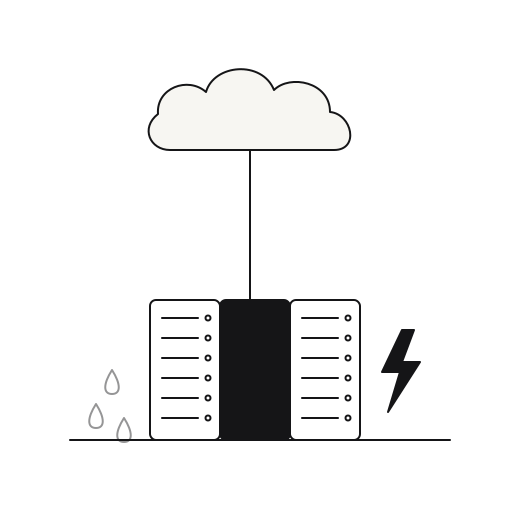
The cloud has an address
When we ask an assistant a question, it feels as if the answer comes from an immaterial cloud. It actually comes from a specific building, full of processors that use electricity, heat up and have to be cooled, often with water. Before that, those processors were made with metals mined from the ground and with large amounts of ultrapure water. At the end of their life they will become electronic waste.
According to the International Energy Agency, data centres used about 415 terawatt-hours in 2024, 1.5% of the world's electricity: more than Italy uses in a year. By 2030 demand is set to more than double, to around 945 TWh, and artificial intelligence is the main driver of that growth.1
A supply chain, not a click
The energy of a single answer is the most visible part, and also the smallest. Behind it lies a long supply chain. Training a large model keeps thousands of processors busy for weeks or months.2 The processors themselves are made in plants that use huge amounts of energy and water. The batteries in devices and storage systems depend on minerals such as cobalt, three quarters of which is mined in a single country.3
Then there is time. A server lasts a few years, a phone often less. Every time we replace hardware to chase bigger models, the bill starts again. A low price, or a free service, does not tell the whole cost.
A book born from a question
"AI: L'Impronta Fantasma" began with a simple question: how much does a conversation with an assistant weigh? To answer it I had to follow the whole supply chain, from cobalt mines to data centres, from cooling towers to electronic-waste dumps. The book has its own footprint too, and I declared it on the first page: about 28 kilograms of CO₂, like a 200-kilometre car journey.
The aim is to make visible a cost nobody sees today, without blaming the people who use these tools: an informed choice needs information.
A price that does not appear on the user's bill, but is paid by the atmosphere, by rivers, by soils, by the most exposed communities.
From AI: L'Impronta Fantasma (translated)
More efficient, more consumption
Every year models become more efficient, and providers are happy to say so. It is true, and it is good news. But it is not enough. In 1865 the English economist William Stanley Jevons observed that more efficient steam engines had not reduced coal consumption: they had increased it, because they made it worth using them for many more things.4
The same is happening with artificial intelligence. An answer that takes less energy pushes us to ask for more of them, to put them into every application, to generate images and videos we would never have requested before. Efficiency lowers the weight of each request, while the total weight keeps growing. That is why per-request figures, on their own, can be more reassuring than they should be.
Measuring to make it lighter
The levers exist and they are concrete: smaller models for simple tasks, data centres powered by renewables, closed-loop cooling, hardware that lasts longer, computing shifted to sunny and windy hours. People who use AI can do their part as well:
- Pick the right tool for the task. A small model is enough to summarise an email.
- Skip unnecessary requests, such as regenerating the same image ten times.
- Settle for a short answer when it is enough.
- Ask providers for the numbers: energy per request, energy mix, water.
It all starts with measurement. That is why I built AI Impact Meter, a Chrome extension ↗ that estimates the footprint of conversations with assistants, a calculator anyone can try here on the site, and a counter that shows, while you read, how much electricity the world's data centres are using.
Artificial intelligence has weight, gives off heat and consumes energy. Yet the bill never reaches the people who use it. Making it visible is the first step to paying less of it.