
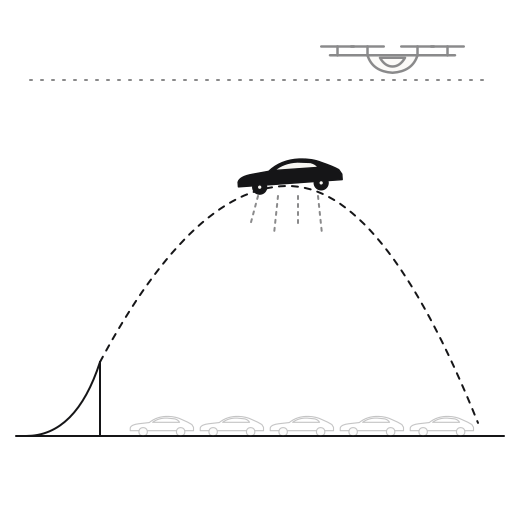
A jump over five cars
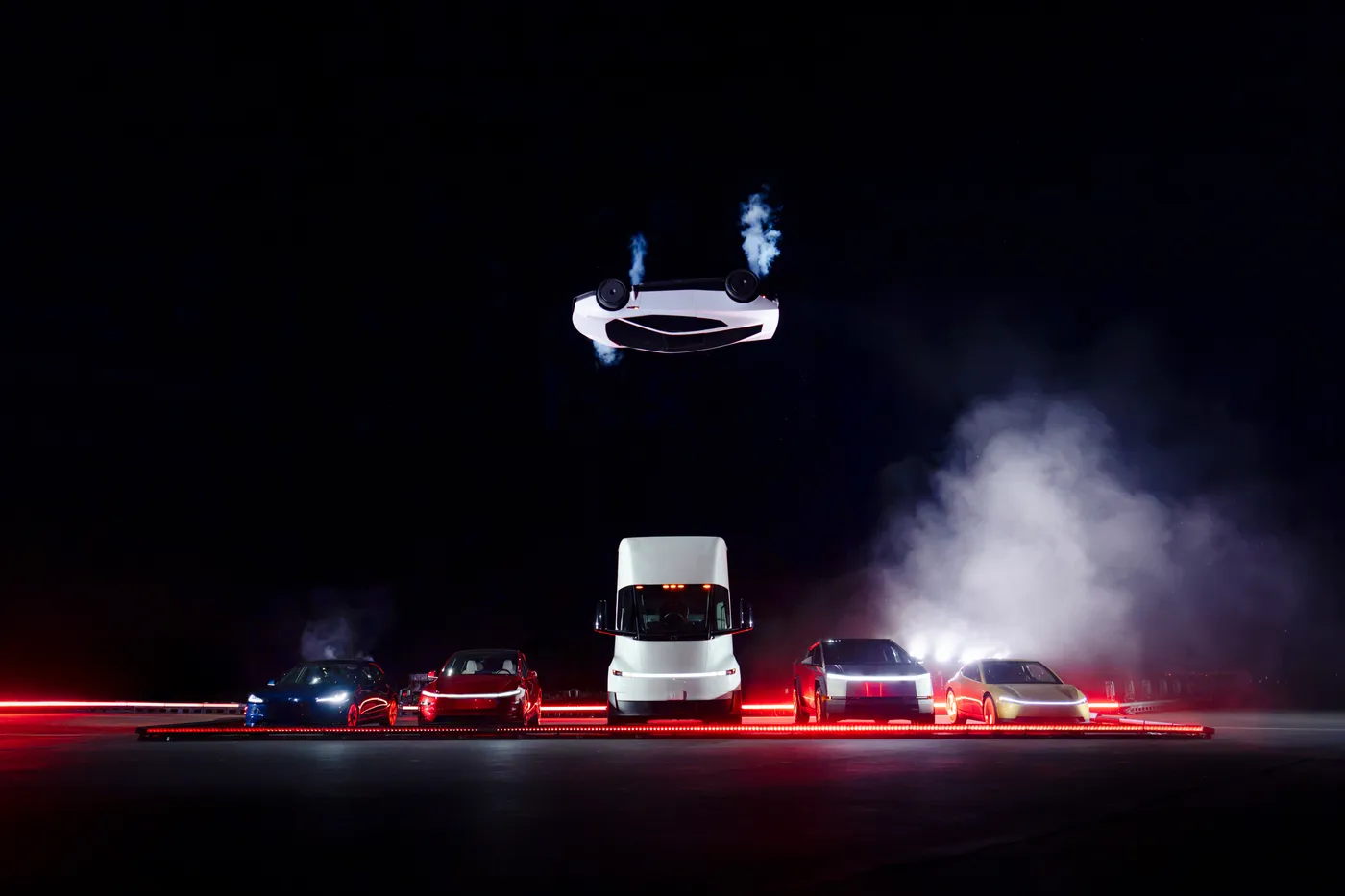
On 15 October, in Texas, Elon Musk finally showed the new Tesla Roadster, first unveiled in 2017 and postponed several times. The highlight lasted a few seconds: the car, with nobody on board, climbed a curved ramp, left the ground and cleared five parked Teslas before landing softly.1
According to Tesla it is lifted by ten thrusters fed by 600 litres of compressed air, stored in carbon-fibre tanks fitted into every free space in the body.1 The announced figures are supercar territory: 0 to 60 mph in under a second, a top speed above 230 mph. Production will start in 2028 and no price was given. Musk himself said safety is not the main goal.
Let us do the maths. Cold-gas thrusters are what satellites use for small course corrections: simple, but not very efficient. Holding a car of about two tonnes in the air means expelling tens of kilos of air every second. Even assuming 300-bar tanks, 600 litres hold about 200 kilos of air: enough for a few seconds of thrust, not for a journey.2 It is a controlled, spectacular jump. It is not a flight.
A century of promises
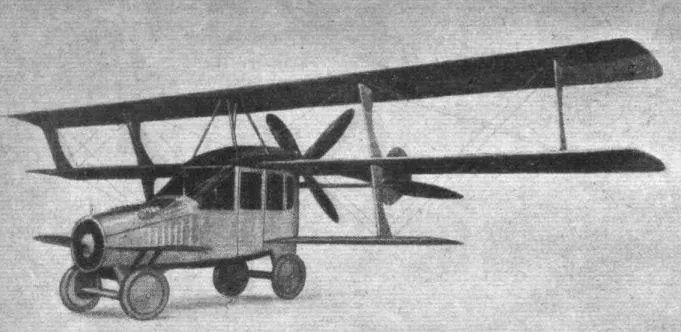
The history of flying cars is full of jumps. The first famous prototype, Glenn Curtiss's Autoplane, managed a few short hops in 1917 and never a real flight.3 In 1940 Henry Ford reportedly promised: "A combination airplane and motorcar is coming. You may smile, but it will come."4
A century of announced flying cars
- 1917Glenn Curtiss's Autoplane makes a few short hops, never a real flight.3
- 1940Henry Ford announces that the airplane-car "will come".4
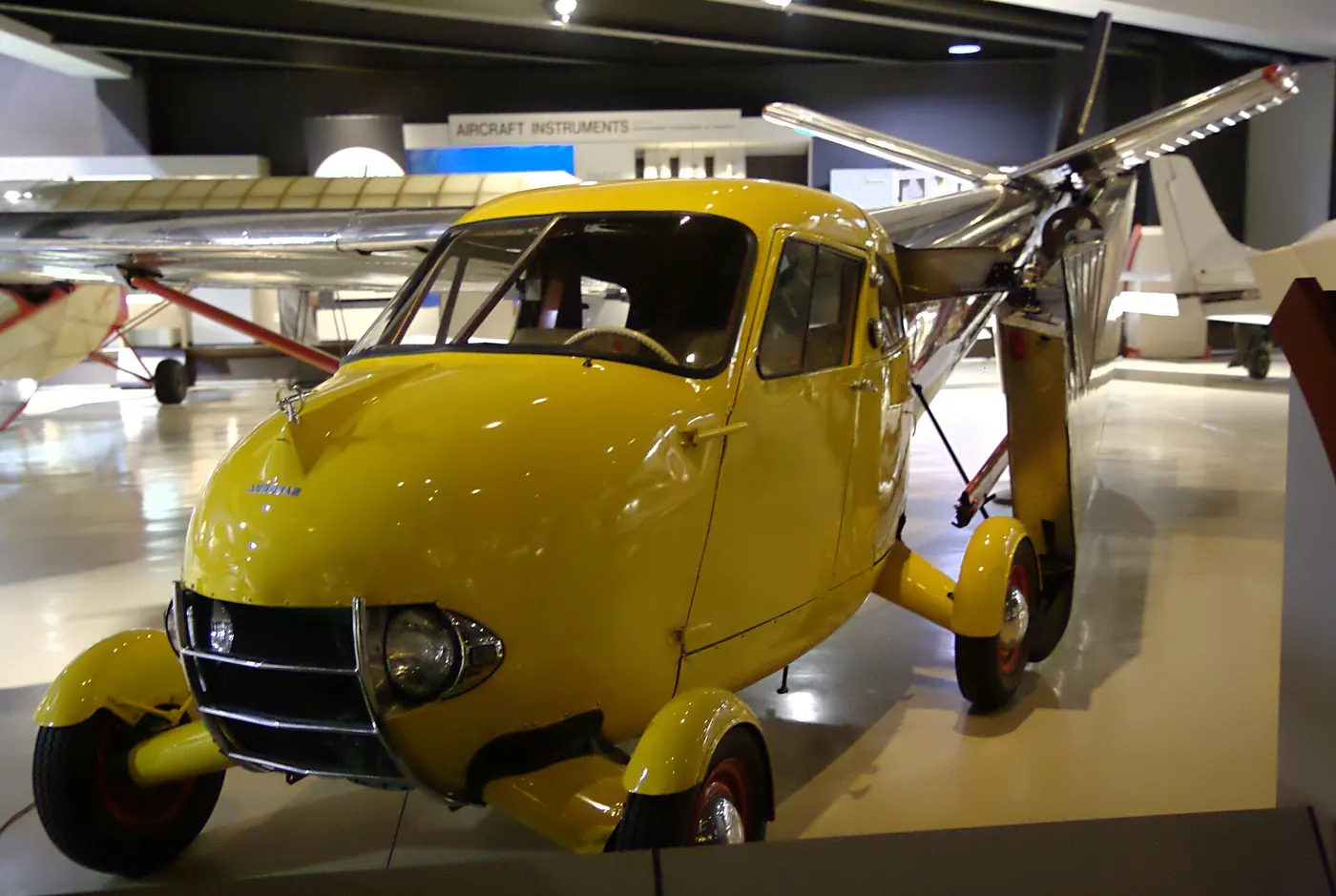
- 1956Moulton Taylor's Aerocar is certified. Only a handful are built, none in series.4
- 1962The Jetsons put the flying car into cartoons all over the world.
- 2022Klein Vision's AirCar gets a certificate of airworthiness in Slovakia. Flying it requires a pilot's licence.5
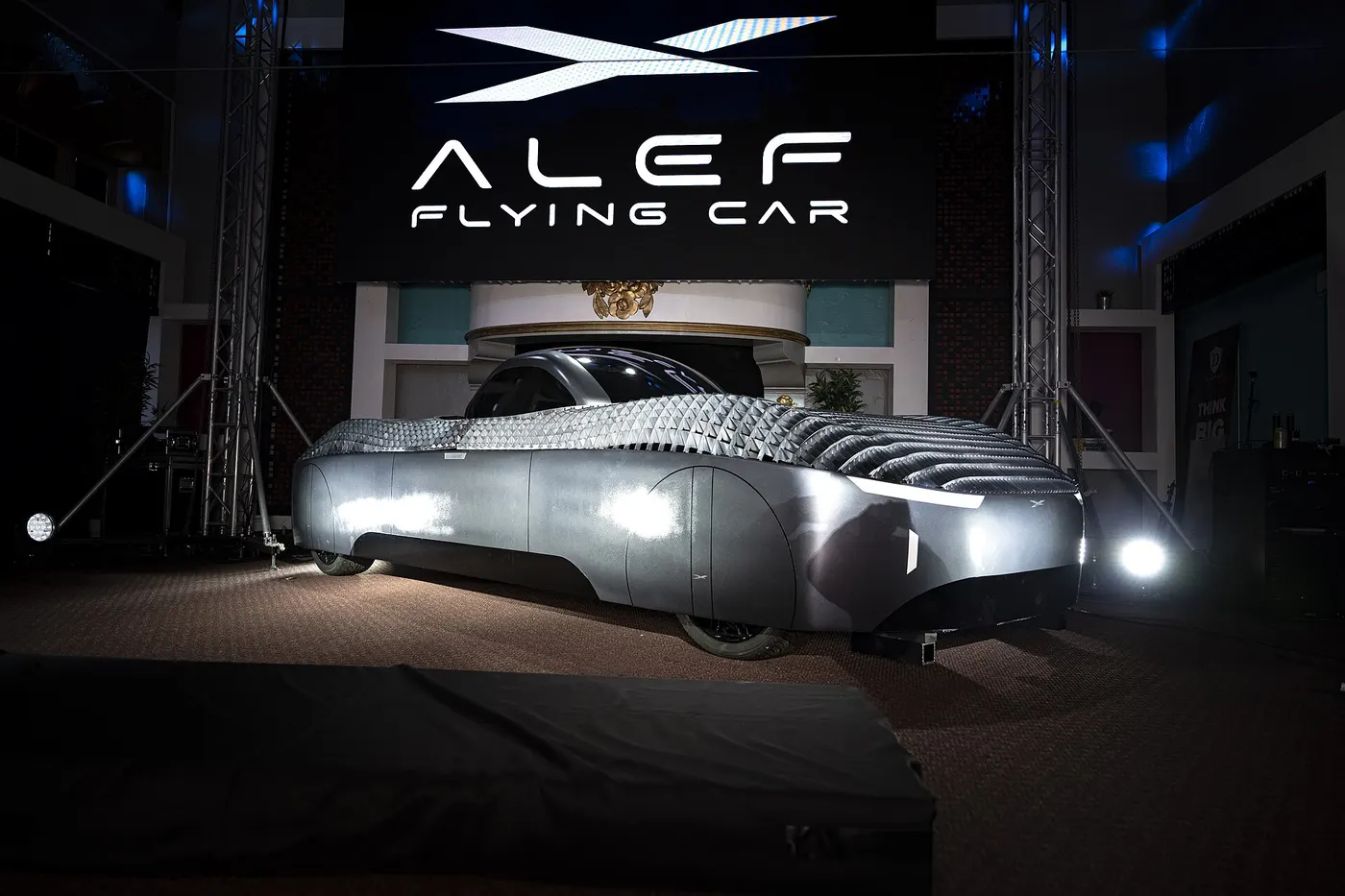
- 2023Alef receives a special FAA certificate for test flights.6
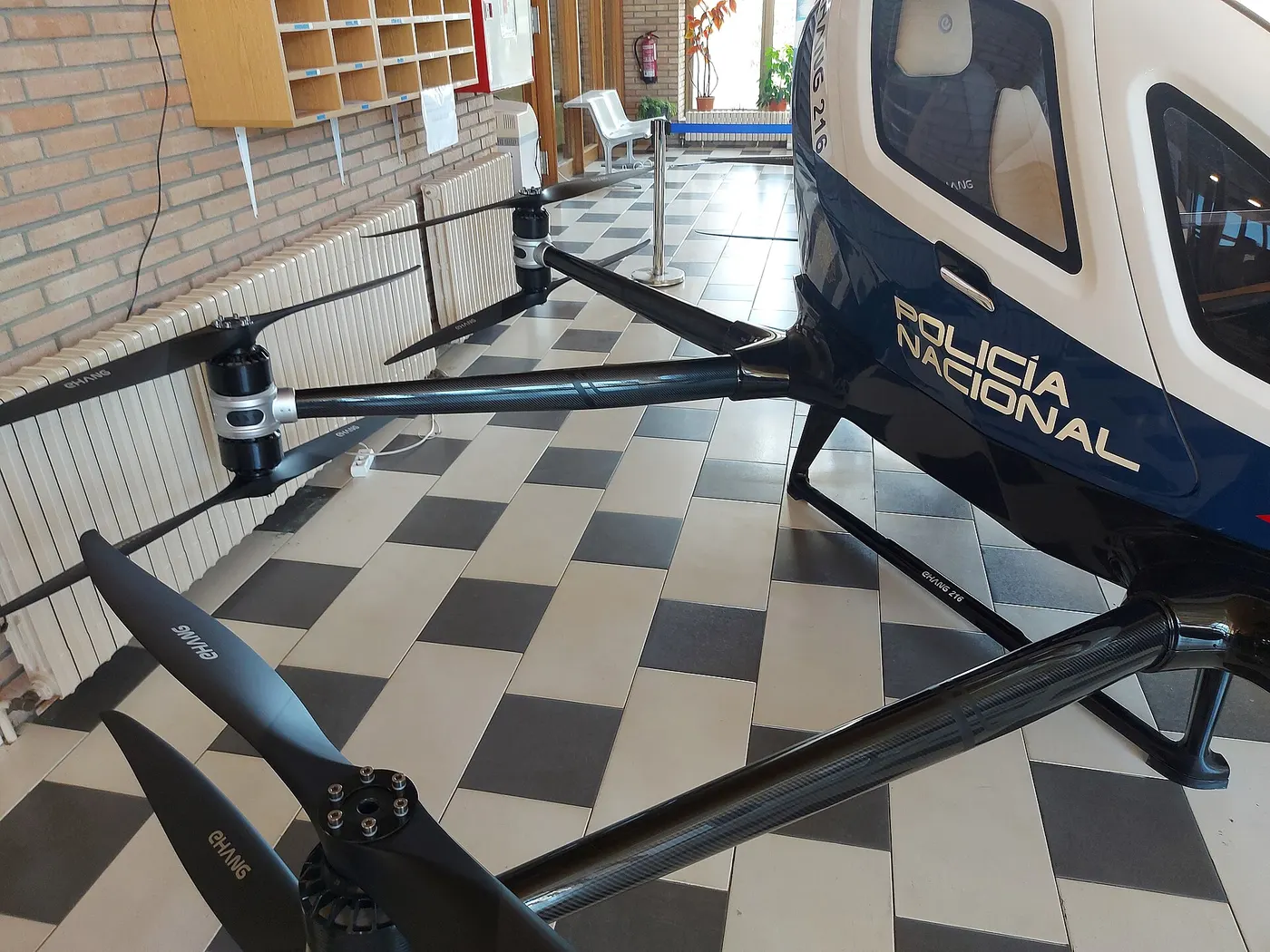
- 2025EHang obtains China's first certificates for commercial passenger flights without a pilot.7
- 2026The Tesla Roadster jumps over five cars. Production announced for 2028.1
Every generation has had its prototype and its date. What has really changed in the past ten years is not the wish to fly, but three technologies: light electric motors, better batteries and automatic flight control. Together they have made possible a new kind of object, which is neither a car nor a helicopter.
Why making a car fly is so hard
A car and an aircraft want opposite things. A car needs weight to stay glued to the road, bumpers, a big battery. An aircraft wants lightness, wide wings or rotors, and cannot pull over when something goes wrong. But the hardest obstacle is the physics of vertical flight.
To hover, a vehicle must push down, every second, enough air to carry its weight. The power required depends on the rotor area: the smaller the rotors, the faster the air must be pushed and the more energy it takes.8 A car that has to fit in a parking space can only have small rotors, and it pays for that choice.
Power needed by a 1.5-tonne vehicle
With an 80 kWh battery, the size of a large electric saloon's, 800 kW lasts six minutes. That is why the most serious projects have wide rotors and often wings too: they take off vertically, then fly like aeroplanes, and in level flight the wing does almost all the work.
Then there is energy. A kilo of jet fuel holds about 11,900 watt-hours, a kilo of today's best lithium cells about 270. According to a study published in Nature, truly expanding electric flight needs battery packs of around 600 watt-hours per kilo, a target reachable within a decade with dedicated investment.9
Energy in one kilo
Then come noise, safety and rules. A helicopter over a city is tolerated because it is rare; a thousand vehicles an hour are not. And every aircraft must be certified like an aeroplane, with standards far stricter than a car's: in the sky you cannot fix a fault by pulling over.
Five ways to leave the ground
How a car can fly: the approaches in play
| Approach | Examples | Strength | Limit |
|---|---|---|---|
| Multicopter | EHang EH216-S, Alef Model A | Simple, takes off vertically almost anywhere | Uses a lot of energy and flies briefly |
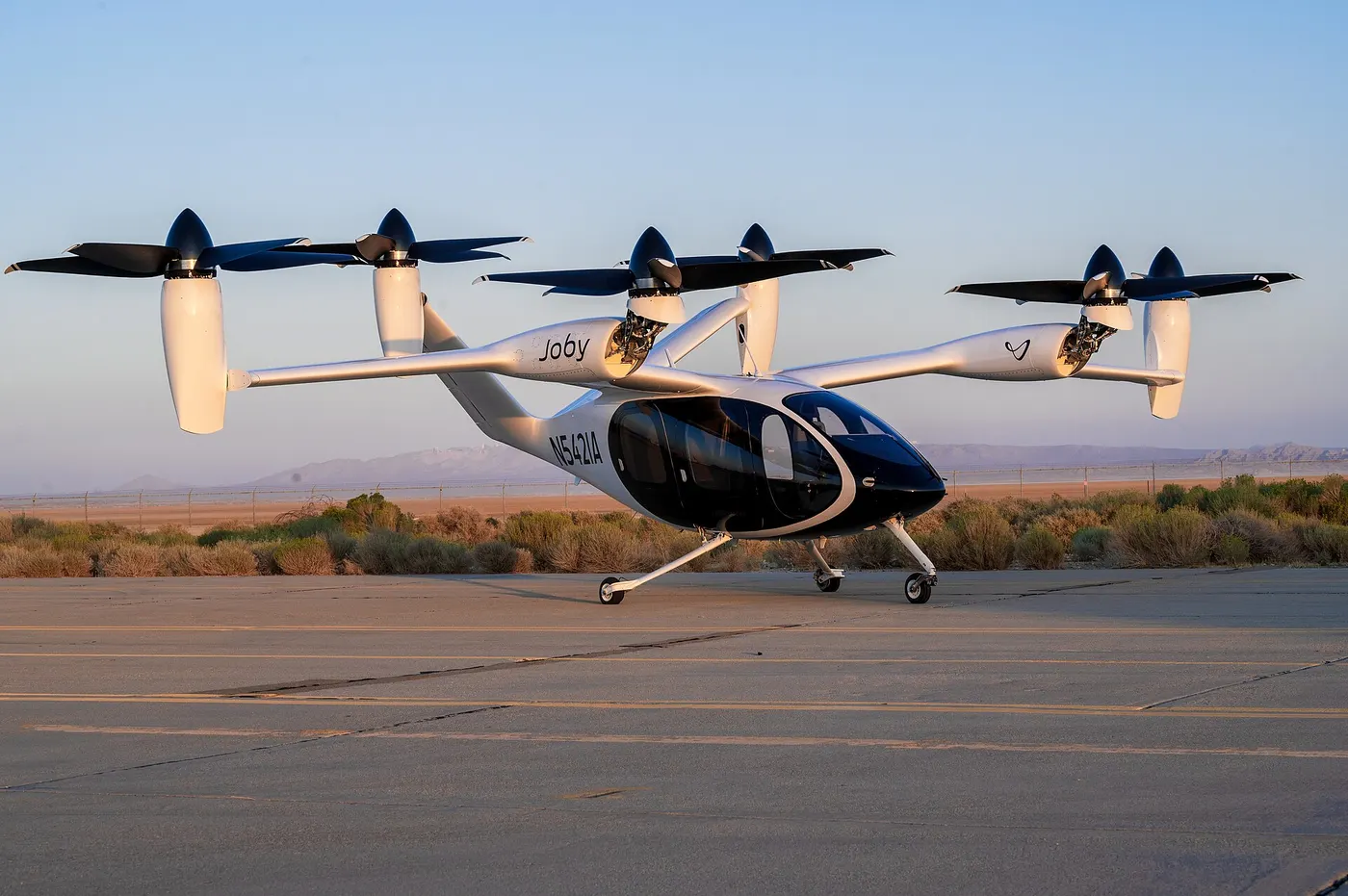
| Tilting rotors and wings | Joby, Archer | Takes off vertically and flies like an aeroplane, faster and further | It is an aircraft: it fits neither a garage nor a road |
| Folding wings | Klein Vision AirCar | A car on the road, an aeroplane in the sky | Needs a runway and a pilot's licence |
| Aircraft in the boot | Xpeng Aridge Land Aircraft Carrier | A six-wheeled van carries a small electric aircraft | Two vehicles in one, double costs and certification |
| Jet thrust | Tesla Roadster | Spectacular, instant response | A few seconds of thrust: it jumps, it does not fly |
Who is closest to real flight
- China. In 2025 EHang obtained the first operator certificates for passenger flights without a pilot, on approved sites and routes, mostly for sightseeing so far.7 The Land Aircraft Carrier from Aridge, Xpeng's company, has more than 7,000 orders and aims for large-scale deliveries in 2027, pending approval.10
- The Gulf. Joby and Archer have chosen Dubai and Abu Dhabi for their first passenger services, where local authorities can approve them before the US FAA. Joby expects to carry its first passengers in Dubai with Uber by the end of 2026.11
- United States. Since 2024 the FAA has rules for the pilots and operations of these aircraft, known as powered-lift.12 But no electric air taxi has yet completed type certification.
- Europe. Here the race has already claimed victims: Lilium and Volocopter, two German pioneers, went into insolvency between 2024 and 2025.13 In Italy ENAC is updating the national strategic plan for advanced air mobility, and testing is under way at a dedicated vertiport at Fiumicino.14
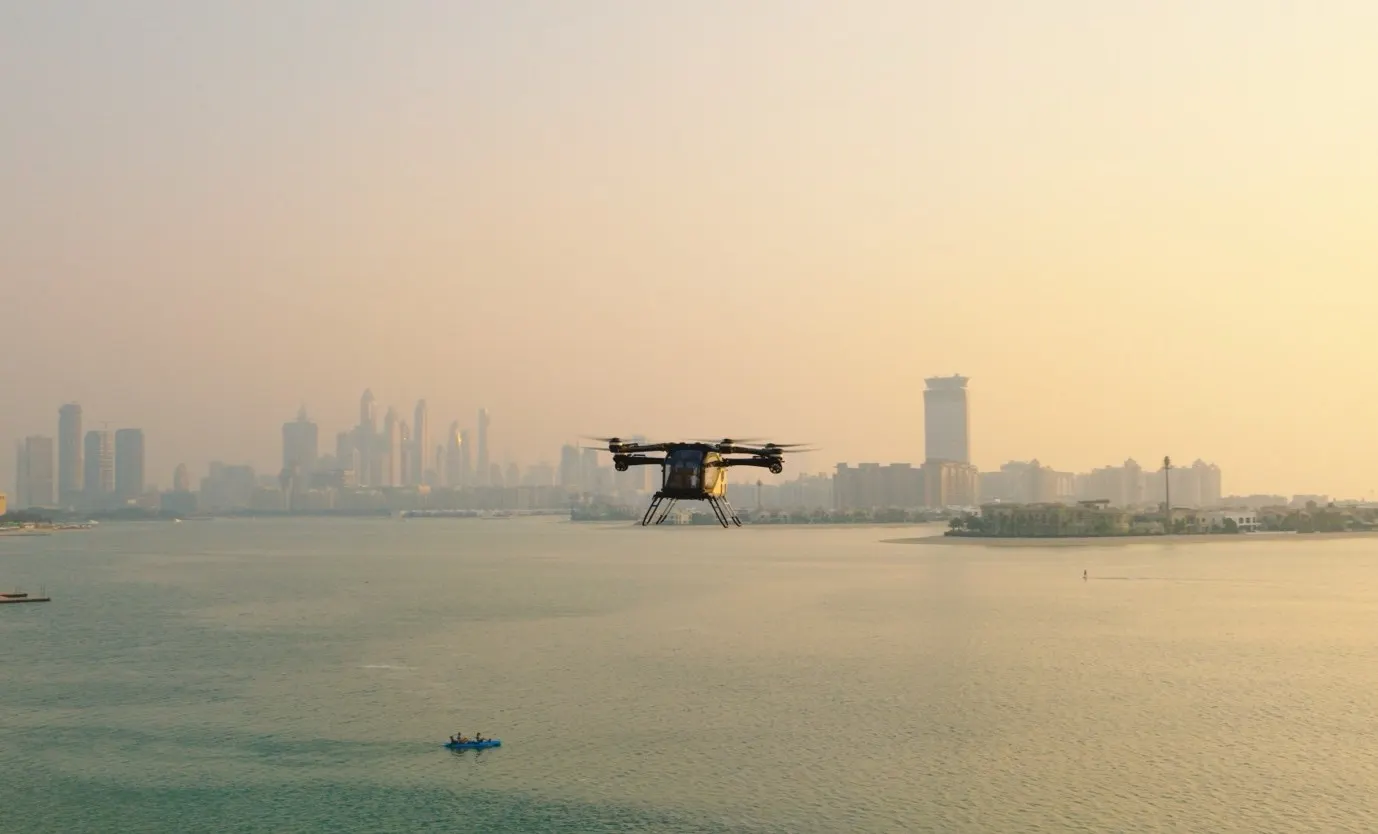
The picture is clear. Real flight is arriving, but not as a car: it is arriving as a small electric aircraft that takes off vertically, carries a few passengers on short, fixed routes and, at first, has a pilot on board.
So, will we get there?
Yes, but not as in the films. The most likely path has four stages.
- TodayJumps and prototypesSpectacular demonstrations, test flights, first sightseeing services in China.
- Until 2030Air taxis on fixed routesA few aircraft in a few cities, vertiport to vertiport, with a pilot and helicopter-like prices.
- The 2030sFewer pilots, more routesAutomated flights, low-altitude traffic managed by software, falling prices if volumes grow.
- LaterThe personal flying car, perhapsOnly if batteries, noise, safety and rules make a real leap. Not like the Roadster's.
The right question is not whether cars will fly, but where we will need them to. In cities the road is still the most efficient way we have to get around. The sky will serve where the road does not reach, or reaches too slowly: airports, islands, mountains, emergencies.
The future always arrives sooner than expected, but rarely in the expected shape. The Jetsons' flying car will most likely become a quiet taxi without wheels, booked through an app. Less romantic, far more useful.