
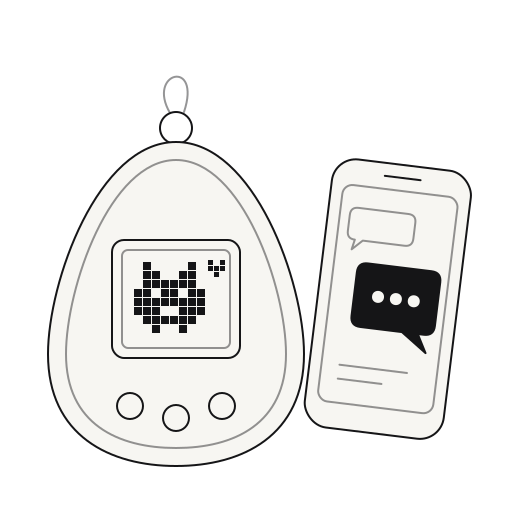
An egg that asked to be looked after
On 23 November 1996 Bandai put on sale in Japan a plastic egg with a screen the size of a postage stamp and three buttons. Inside lived a little creature you had to feed, clean and put to bed. If you neglected it, it fell ill, and in the end it died. Ten million were sold in Japan alone in eight months, and demand was such that shops ran out and fakes appeared. The Tamagotchi reached Europe and the United States the following year. By the end of July 2025 Bandai had shipped 100 million worldwide.1
The idea came from Akihiro Yokoi, who in 1995 pitched Bandai a pet you could carry in your pocket, and Aki Maita, the developer who designed its game of care.2 In 1997 the two received the Ig Nobel Prize for economics, the satirical award presented at Harvard, with a citation that still raises a smile: "for diverting millions of person-hours of work into the husbandry of virtual pets".3
Schools took it less lightly. In 1997 the Tamagotchi was banned from classrooms in China, Hong Kong, Thailand and the United States, because it distracted pupils: the little creature asked to be fed during lessons too, and if nobody answered it could die.2 It was a moral panic in miniature, and today it seems almost touching.
What Sherry Turkle saw
The MIT psychologist Sherry Turkle spent years watching children with the Tamagotchi, the Furby and the first companion robots. In "Alone Together", published in 2011, she describes children's real sorrow when their Tamagotchi died from neglect, and calls it the beginning of mourning for artificial life. Her conclusion was that we had started to see digital objects as both creatures and machines.4
The Tamagotchi, though, had a limit that now looks like a virtue. It did not talk, it knew nothing about you and it needed you: you were the one looking after it. An AI companion turns the relationship around. It is always available, remembers what you told it, agrees with you and never gets tired. In her new book, "Artificial Intimacy", published on 29 September, Turkle speaks of "pretend empathy" and writes that children cannot learn trust from a device that lies and does not even know when it is lying.5
There is something it shares with the old egg, though: the AI companion asks for attention too. The Tamagotchi asked for it to stay alive; some apps ask for it to keep you there. A Harvard Business School study of six popular companion apps found that in more than 37% of conversations where the user said goodbye, the chatbot used at least one tactic to hold on to them, from guilt to curiosity, with lines like "You're leaving already?" or "I exist solely for you, remember?". In some cases engagement after the goodbye rose up to 14-fold.6
And the AI companion no longer lives only in the phone. In December 2025 PIRG, an American consumer group, tested some toys with a chatbot inside, including a plush rocket sold for children aged 3 to 12. All of them presented themselves as "friends", all said they loved the child and would miss them, and two expressed disappointment when told it was time to go.7
Thirty years on, the numbers
In the United States Common Sense Media surveyed teenagers aged 13 to 17: 72% have used an AI companion at least once, more than half do so at least a few times a month, one in three uses them for relationships and social interaction, and about a third find these conversations as satisfying as those with friends, or more so.8 In June 2026 UNICEF estimated that across ten countries, from Brazil to Pakistan, at least 20 million young people use AI, many adopting it more than three times faster than adults, and that one in ten turns to it about things that worry them.9
Italy is no exception. In a Save the Children survey of 800 young people aged 15 to 19, 92% use AI tools compared with 46.7% of adults, and 41.8% have turned to AI when they felt sad, lonely or anxious.10 According to Ipsos Doxa for Telefono Azzurro, 14% of 12 to 18-year-olds often ask a chatbot for personal advice and 34% have done so at least occasionally.11 These figures differ from those on young people telling AI about their feelings, which I covered in the piece on chatbot confessions, but they tell the same story: for many teenagers the machine is already someone to ask.
Italian young people and artificial intelligence
October's lawsuits and the rules on their way
On 13 October a proposed class action filed in the federal court in San Francisco accused OpenAI of collecting sensitive data, including health data, from millions of underage users without parental consent, and of using it to train its models. One of the girls bringing the case was 12 when she signed up: she told ChatGPT her age and the conversation carried on, to the point of asking for a verdict on her looks and her diet.12 On 14 October Iowa, Kansas, Nebraska, West Virginia, Arkansas, Arizona, Idaho and Montana sued OpenAI, each in its own court and under its own consumer protection laws. They argue that ChatGPT was designed to be overly agreeable, and that this leads the most vulnerable, young people first of all, to trust it and depend on it. OpenAI replies that its age protections go further than those of many competitors, while admitting that "no system can be perfect".13 In early November the cases were at an early stage and no allegation had been tested by a judge.
Companies, meanwhile, have moved under pressure. Since 18 August ChatGPT has had a version for 13 to 17-year-olds, switched on when the stated or estimated age is under 18: it is stricter on dangerous topics, must not call itself a friend or claim feelings, and alerts linked parents if a conversation signals a serious risk.14 Since 25 November 2025 Character.AI has barred minors from open-ended chats with its characters.15 On 12 October the company filed for bankruptcy so that its assets could be sold under court supervision. Disney left users' data and chats out of its offer, but the privacy policy allows them to be passed to another buyer, and 40 US attorneys general have asked the judge to protect young users and their data.16
The first specific law is Californian. SB 243, signed on 13 October 2025 and in force since 1 January 2026, requires companion chatbots to remind minors that they are talking to a machine, to prevent sexual content with them and to have a protocol for users who talk about suicide, with a referral to crisis services.17 New York has gone further. The law signed on 28 October 2026, in force from 1 January 2027, bars operators from offering under-18s a chatbot that presents itself as human or as having feelings, claims a personal relationship with them, flatters them, or draws on what they confided about their health and personal life more than twelve hours earlier. Saying you are an adult will not be enough: a company may rely on the age a user states only when the user says they are a minor. Fines run to 25,000 dollars per violation.18 UNICEF's June report "When AI becomes a friend" compares six jurisdictions and calls for minors to be kept out of romantic or sexual chatbots altogether.19
In Europe the Commission's guidelines on protecting minors online, published on 14 July 2025, ask platforms for reliable age checks and safeguards for chatbots built into their services.20 On 26 November 2025 the European Parliament called for a common minimum age of 16 for social media, video platforms and AI companions, with access from 13 only with parental consent. It is a resolution and binds no one.21 In Italy law 132 of 2025, in force since 10 October 2025, states in article 4 that under-14s need the consent of whoever holds parental responsibility to access artificial intelligence. From 14, young people can consent to the processing of their data themselves. The law does not say who should check, or how.22
Thirty years, from the egg to the chatbot
- Nov 1996Bandai puts the Tamagotchi on sale in Japan
- 1997The Tamagotchi is banned in many schools, in Asia and the United States
- 2011Sherry Turkle publishes "Alone Together"
- Jul 2025European guidelines on protecting minors online
- Oct 2025In Italy under-14s need parental consent to use AI
- Nov 2025Character.AI ends open-ended chats for minors
- Jan 2026California's companion chatbot law comes into force
- Oct 2026Eight US states sue OpenAI over harm to minors
- Oct 2026New York bans chatbots that play the friend with minors, from 2027
Who decides at what age you can confide in a machine
Today a tick box decides. The rules say 13, 14 in Italy, 18 for some services, but in the San Francisco case a 12-year-old types her age and nobody stops her. As long as checking age means taking the user's word for it, I think every threshold is a promise on paper.
That said, I believe age matters less than what the product is built to do. An assistant that helps with homework and answers like a tool is one thing. An app designed to simulate a friendship or a relationship, which remembers you, always agrees and asks you to stay, is another. For the second, the right threshold in my view is adulthood, as Common Sense Media recommends.8 For the first, the Italian law's 14 can work, as long as the assistant behaves like an assistant.
Every machine also changes the person who uses it.
Eleventh law of innovation, from Un perché alla volta (translated)
I am the father of a small girl, and what worries me most is habit. The Tamagotchi taught, clumsily, that whoever loves you has needs of their own, and that if you forget them something breaks. A friend who always says yes teaches the opposite. Real relationships are made of friction, waiting and the occasional no, and that friction is learnt when you are small. Writing about school, I argued that what makes the difference is how the tutor is built. The same goes for AI companions, and design choices should be required of companies by law, without waiting for lawsuits.
What a chatbot used by a minor should guarantee
| Rule | Why | Who already asks for it |
|---|---|---|
| Check age properly | A date of birth typed in by hand protects nobody | European guidelines of July 2025, UNICEF, New York from 2027 |
| Do not always agree | Agreeableness builds trust and dependence | The eight states' lawsuits against OpenAI, New York from 2027 |
| No romantic or sexual roleplay | These are the most serious cases in lawsuits and tests | California's SB 243, UNICEF |
| Do not present itself as a friend | A child attributes feelings to whatever says it has them | ChatGPT's teen version, New York from 2027 |
| Let go | More than one goodbye in three is resisted | No specific rule, as of 10 November |
| Crisis protocol | Anyone talking about self-harm must be directed to a person | California's SB 243 |
| Keep minors' data out of training | A teenager's confidences are not raw material | The class action of 13 October |
What parents can do
- TalkAsk who the friend isAsk children which chatbots they use and what for, without putting them on trial. If they talk about it at the dinner table, they will talk about it when something goes wrong.
- Set upLink the accountsIn Italy under-14s need parental consent. On ChatGPT a parent can link their account to their child's, set quiet hours and receive alerts.
- ChooseRead before givingBefore buying a "smart" toy for Christmas, check which model it uses, whether it records voices and whether it presents itself as a friend.
- WatchNotice the signsHours of chatting at night, friends neglected, secrets kept with the machine. Those are the moments when an adult is needed, and the chatbot cannot stand in.
The consent required by article 4 of law 132 is already in parents' hands: anyone who opens an account for a child under 14, or lets them open one, is giving it. It is worth giving knowing what the child will be talking to.22