
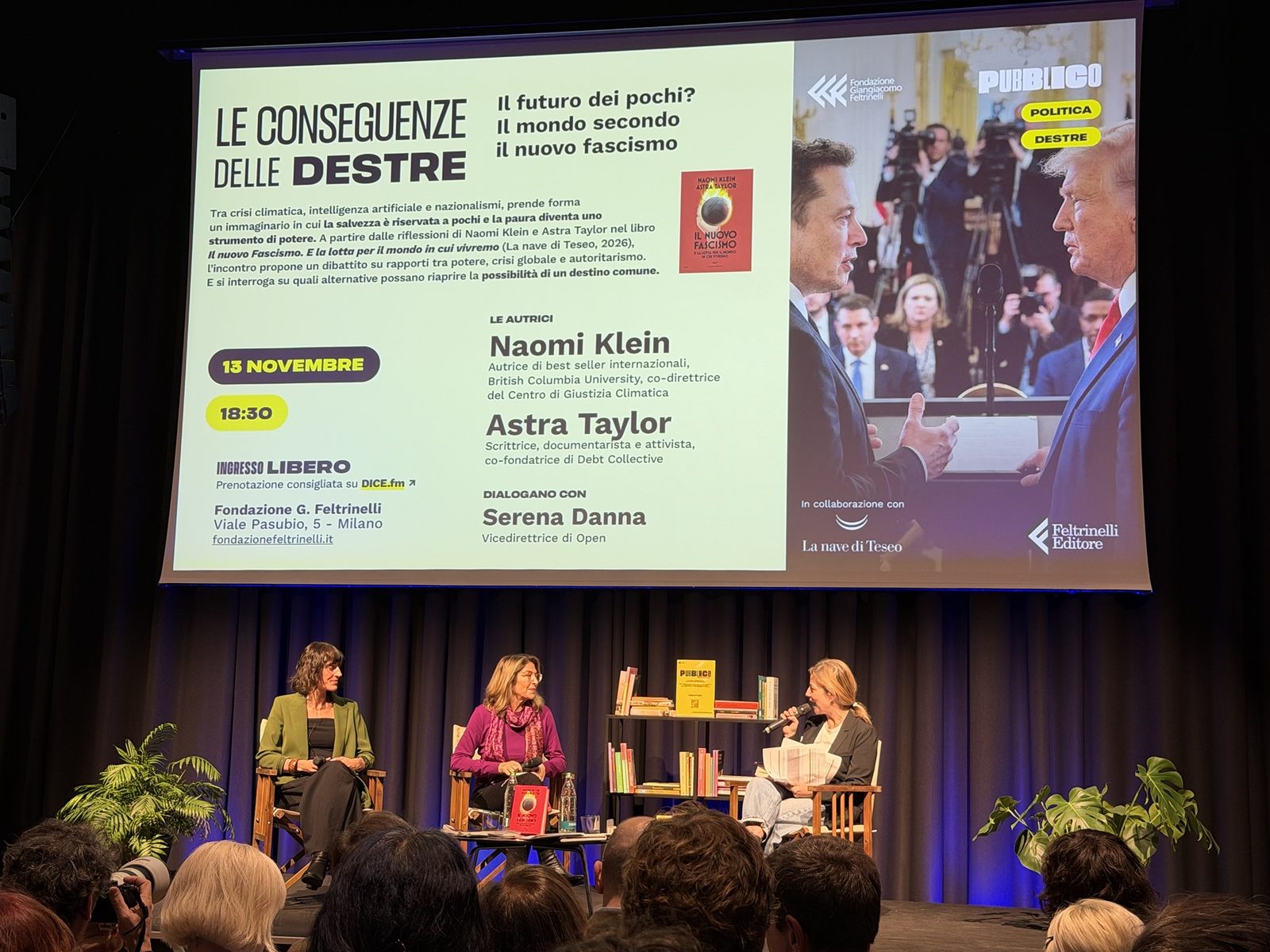
Friday 13 November, at the Feltrinelli Foundation
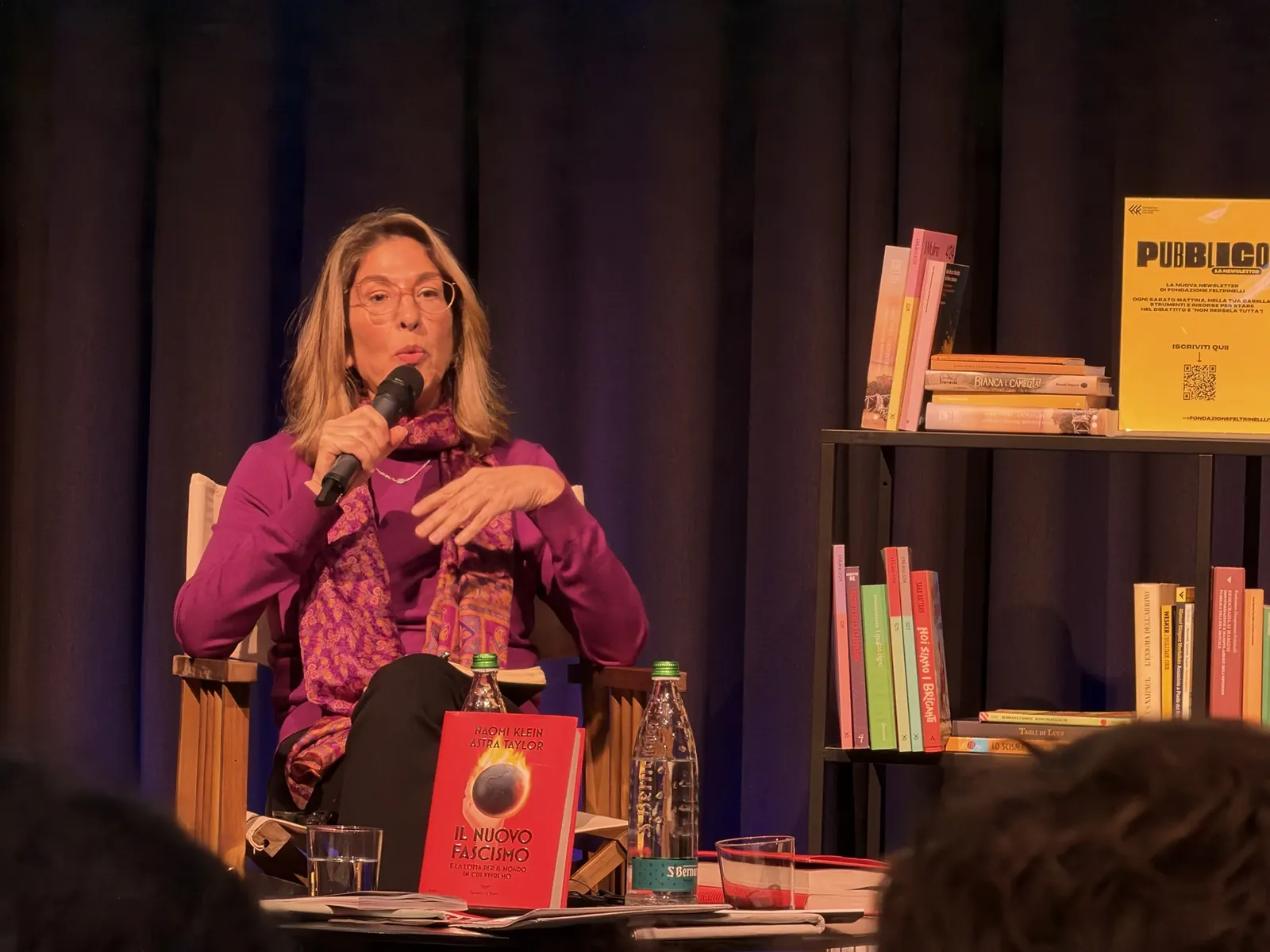
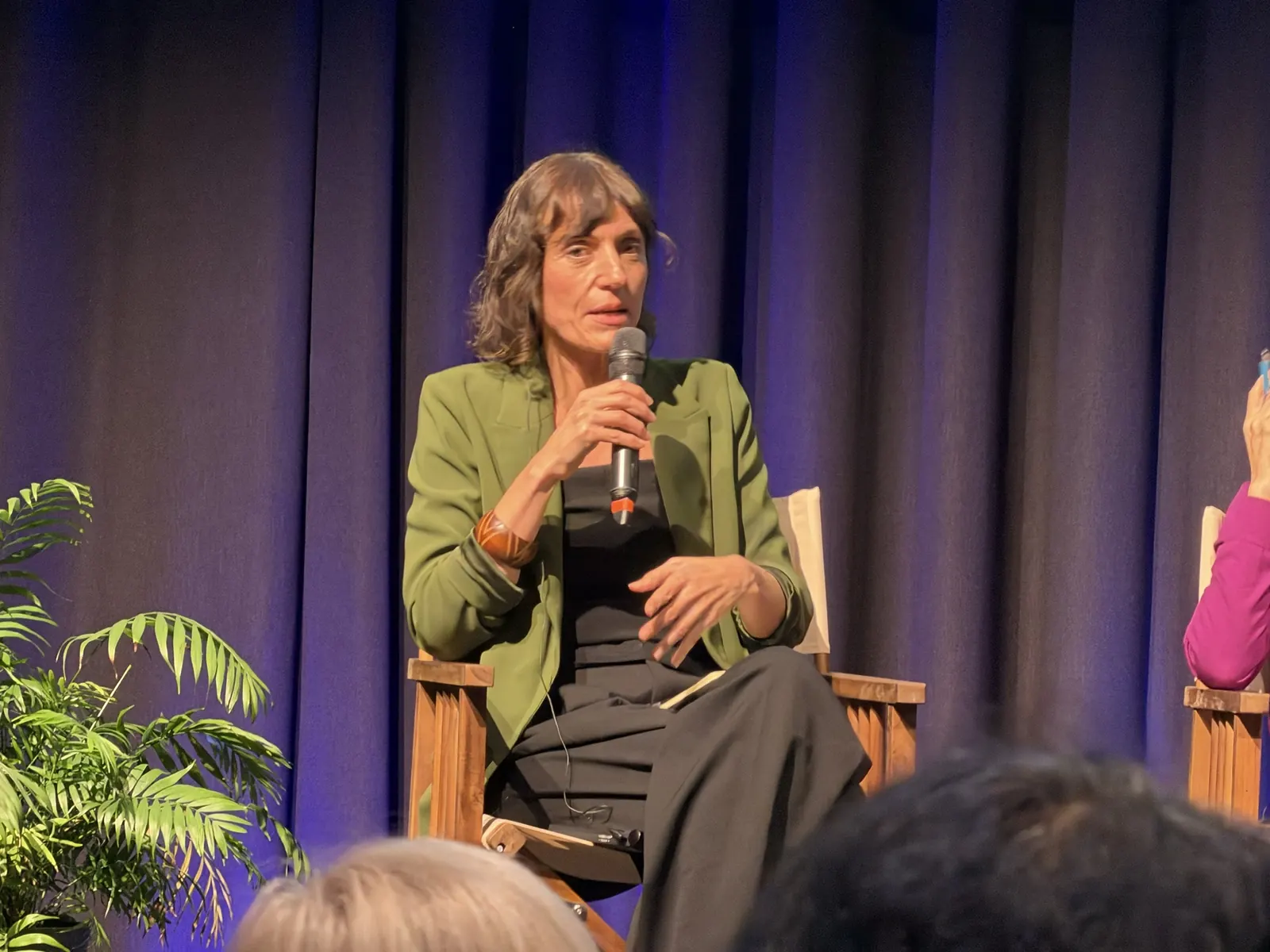
On Friday 13 November I was at the Giangiacomo Feltrinelli Foundation in Milan to listen to Naomi Klein and Astra Taylor. They were presenting the book they wrote together, published in English in September as “End Times Fascism and the Fight for the Living World” and in Italy on 27 October by La nave di Teseo.1 Serena Danna, deputy editor of Open, was on stage with them. The evening was called “Le conseguenze delle destre”, the consequences of the right, and the invitation opened with a sentence that sums up the book well: amid the climate crisis, artificial intelligence and nationalism, a picture is taking shape in which salvation is reserved for the few and fear becomes a tool of power.2
I thought about it all weekend. What struck me was how central technology is to their analysis, not as a backdrop but as one of the engines. And I came home with a question that touches my own work closely: how should people behave if they see technology differently, as something free and democratic, but still want to work with it, build companies and do business?
The argument: a future for the few
Klein and Taylor first set out the idea on 13 April 2025, in a long essay in the Guardian called “The rise of end times fascism”.3 The reasoning, in short, goes like this. For decades the people running the economy promised that growth would bring prosperity to everyone. Part of the richest elite, with many Silicon Valley founders at the front, has dropped that promise. It is preparing for a world of crises, climate and political, and for saving itself in bunkers, private enclaves and “freedom cities”. The essay's examples are concrete, from Mark Zuckerberg's underground shelter in Hawaii to Peter Thiel's land in New Zealand. Everyone else gets harder borders and fewer rights.
Naomi Klein has been writing for more than twenty years, from “No Logo” to “The Shock Doctrine”, around one fixed idea: those in power use crises to take more of it. Astra Taylor is a writer and documentary maker, and a co-founder of the Debt Collective, an American organisation of people in debt who act together.
In this picture the big technology companies play a precise role. They own the platforms where public opinion takes shape, the data centres and the artificial intelligence models. And more and more often they choose to stand beside political power rather than act as a counterweight to it.
From free technology to one side's technology
The thought that stayed with me is this: artificial intelligence risks moving from free technology to one side's technology. A language model has no political ideas. But a handful of companies control its computing power, its data and its distribution, and some of them have chosen to stay close to those in government. In the United States today, that means Donald Trump's right.
The steps are public. In December 2015 OpenAI was founded as a non-profit, to advance artificial intelligence “in the way that is most likely to benefit humanity as a whole, unconstrained by a need to generate financial return”.4 On 7 January 2025 Meta announced the end of fact-checking by outside experts in the United States, and Zuckerberg said he would work with President Trump to push back on foreign governments demanding more controls, Europe included.5 On 20 January, at Donald Trump's inauguration, the Capitol Rotunda held Elon Musk, Amazon's founder Jeff Bezos, Mark Zuckerberg and the head of Google, Sundar Pichai.6 On 23 July the White House signed a presidential order on “preventing woke AI”: federal agencies may only buy models that are “neutral” and “nonpartisan”, by the government's own criteria.7 On 28 October OpenAI completed its reorganisation: the part that builds and sells the models became a for-profit public benefit corporation, under the formal control of the foundation.8
Ten years of artificial intelligence, from promise to power
- Dec 2015OpenAI is founded as a non-profit
- Jan 2025Meta ends outside fact-checking in the United States
- Jan 2025Musk, Bezos, Zuckerberg and Pichai at Trump's inauguration
- Jul 2025Presidential order: models bought by the government must be “neutral”
- Oct 2025OpenAI completes its move to a for-profit company
The July order is the most subtle step. When a government decides what “neutral” means for a language model, and the companies selling it fall into line so as not to lose public contracts, artificial intelligence becomes political in the most concrete sense. It answers the way its buyer wants.
Then there is the question of who builds it. According to Stanford University's AI Index, there were 102 notable artificial intelligence models in 2025: companies made 93 of them, universities 2.9 The report adds that the most powerful models are also the least transparent, because for several systems from OpenAI, Anthropic and Google the training code, the number of parameters and the amount of data used are no longer disclosed. I wrote about dependence on a few suppliers in “Who holds the keys?”.
Who made the most important artificial intelligence models of 2025
Yet free technology is not a memory. On 30 April 1993 CERN put the World Wide Web software into the public domain, which is why the web has no owner.10 Linux, Wikipedia and the internet's protocols were built in common, and they still hold up a good part of the digital world. I have used Linux for twenty-five years, and I told its story in the piece on Linux Day: that road is still open to anyone who chooses it.
The question: doing business without serving power
Back to the question I brought home. If you believe in free, democratic technology, but you work with it and want to earn a living from it, how should you behave?
Doing business, in my view, is not the problem. Free software has given rise to companies large and small, and people who write open code have every right to be paid. The problem starts when a company depends on a few suppliers who can change the rules overnight, or when it accepts uses of technology it would never show in public. Here people who work with technology have more room than they think, because they choose the suppliers, write the contracts and say yes or no to clients.
I have arrived at four simple rules, in order of effort.
- Know how to leaveBefore adopting a tool, ask where the data lives, in what format it can be taken away and what it costs to switch supplier.
- Prefer what can be checkedOpen standards, free software and models with published weights, whenever they are good enough for the job.
- Give back to the commonsIf a company lives partly on free software, some of what it earns should go back to the people who maintain it.
- Put the limits in writingThe uses you will not accept, from clients and suppliers alike: surveillance of people, manipulation, decisions about people with no human answerable for them.
Then there is Europe. European rules, from the AI Act to the Digital Services Act, are often described as a brake on business. For anyone who wants a different kind of technology they are an ally, because they set limits that apply to everyone, including those with more money and more lawyers. The AI Act, for instance, lightens the documentation duties for models released under a free and open licence, as long as they carry no systemic risk.11 And on 3 June 2026 the European Commission adopted a strategy for open digital ecosystems: it backs open standards in public procurement and acknowledges that tenders have so far worked against suppliers of free software.12
What I think
I think Klein and Taylor are right on the point that concerns me most. Today's technology is not neutral about power, because it sits in very few hands, and some of those hands have chosen to stand beside those in government. The word “fascism” is theirs, and they back it with arguments. For me it is enough to line up the facts: a few companies, a great deal of power, and a growing readiness to fall into line with a government.
I do not think, though, that the answer is to give up technology, or business. Artificial intelligence can stay a free tool if enough of the people who build it and buy it insist on being able to check it, take it away and govern it with public rules. People who work with it are not spectators: every supplier chosen and every contract signed moves a little power one way or the other.
The first step costs little. Next time your company chooses an artificial intelligence tool, ask the supplier in writing how you leave: where the data ends up, in what format you get it back and how long it takes.