
From advice to action
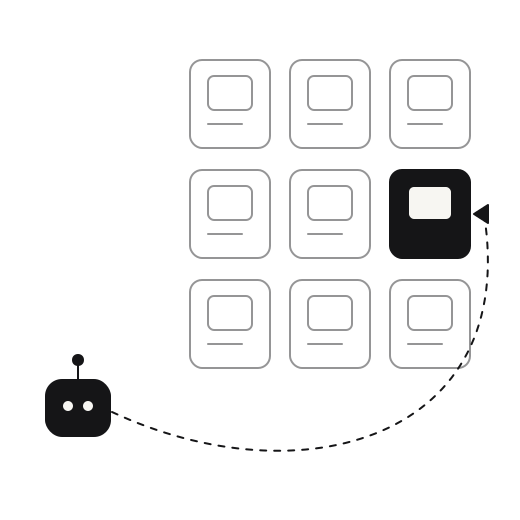
For years algorithms have suggested what to watch, listen to and buy. The last word stayed with us. AI agents change that balance: they receive a goal, break it into steps, use tools, compare offers and complete transactions. They book, order, pay.
Gartner expects that by 2028 at least 15% of day-to-day work decisions will be made autonomously by systems like these, up from zero in 2024, and that a third of enterprise software applications will include agentic features.1 The same firm also estimates that over 40% of projects started will be cancelled by the end of 2027, because of costs, unclear value or inadequate controls.2 Both are true: the direction is set, and the road is full of false starts.
An agent fills the basket
Commerce is the first ground where this shift becomes concrete. In September 2025 OpenAI and Stripe presented the Agentic Commerce Protocol, an open standard that lets an assistant complete a purchase without the user leaving the conversation. In the same days Google announced AP2, a protocol designed to prove that a payment made by an agent was really authorised by a person, developed with dozens of partners including American Express, Mastercard and PayPal.3
Beyond the individual products, which will change, the signal is clear. The infrastructure that lets machines shop on our behalf is being built now, and whoever runs payments, catalogues and logistics is already setting the rules.
When the customer is a machine
This is the part I follow most closely in my work. When an agent chooses a product, advertising designed for the human eye matters less. What counts is clear data, readable prices, verifiable reviews, transparent terms. A brand has to make itself understood by whoever reads on people's behalf, without losing what makes it recognisable to the person who will then use the product.
For a company this turns into very concrete work:
- Make product data readable: features, availability and up-to-date prices, in formats a system can interpret without ambiguity.
- Look after reviews and terms. An agent compares; it is not seduced by a slogan.
- Decide where to be present, because some assistants will become shop windows and others will not.
- Measure how much of your traffic and orders already comes from an agent, so you do not notice too late.
The market changes shape too. If a few assistants become the front door to shopping, whoever controls them decides what we see first. It is a question of competition before it is a question of technology, and it leads to another one: who holds the keys?
Machines that learn no longer do only what we say. They do what they have learned. And what they have learned does not always match what we want.
From Un perché alla volta (translated)
Before delegating
Before handing a choice to a machine, it is worth answering four questions, the same ones I ask in "Un perché alla volta":
- Which actions can it take on its own, and which can it not?
- Who checks what it does?
- What happens when it gets it wrong?
- Who is responsible?
They sound like questions for engineers, but they are questions for people. They apply to a company that lets an agent manage its orders and to a family that trusts it with the weekly shopping.
Europe has already drawn a line. Under the AI Act, systems that decide who gets hired or who gets credit are classed as high-risk, with duties of transparency and human oversight.4 For most other uses, the rule is written by whoever designs these systems and whoever chooses to adopt them.
When a machine acts, part of the decision passes to it. We need to decide which part, and who answers for it.