
Black cardboard in Würzburg
On 8 November 1895 Wilhelm Conrad Röntgen was working late in the laboratory of the Physics Institute in Würzburg.1 He was studying cathode rays with a glass tube covered in black cardboard when he noticed that a fluorescent screen some distance away was glowing.2 No light could get out of the tube, so something else was passing through the cardboard. Not knowing what they were, he called them X-rays.
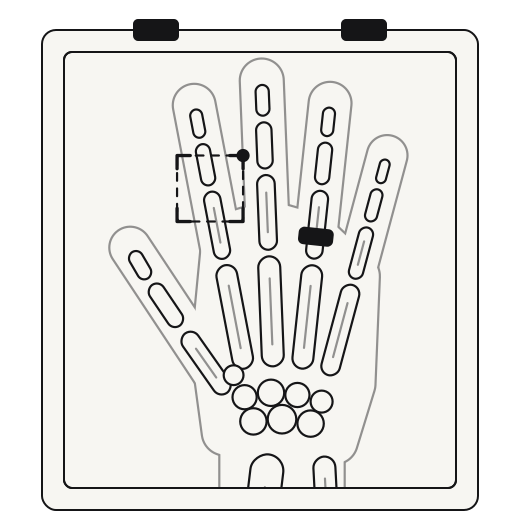
In December he photographed the hand of his wife Bertha, bones and ring clearly visible, and on 28 December he submitted his paper "On a New Kind of Rays" to the Würzburg Physical-Medical Society.12 He refused to patent the discovery because he wanted it to benefit everyone. On 10 December 1901 he received the first Nobel Prize in Physics and gave the whole prize money to the university.1
Medicine moved quickly. By February 1896 X-rays were already being used on patients in the United States, and within a year they had become an established part of medical practice.2 With them came a job that had not existed before, that of the doctor who reads shadows on a plate. A hundred and thirty-one years later, it is one of the jobs most often said to be on the way out because of artificial intelligence.
From Bertha's hand to AI
- Nov 1895Röntgen observes in Würzburg the rays he calls X
- Dec 1895The X-ray of Bertha's hand and the first paper
- Feb 1896X-rays are already used on patients in the United States
- Dec 1901Röntgen receives the first Nobel Prize in Physics
- Nov 2016The video of Hinton saying we should stop training radiologists is published
- May 2025Hinton admits he got the timing wrong
- Jun 2026The FDA counts 1,230 AI-enabled devices for radiology
The 2016 prediction
In 2016, at a machine learning conference in Toronto, Geoffrey Hinton, one of the fathers of neural networks, compared radiologists to the cartoon coyote that has already run off the edge of the cliff but has not yet looked down. "People should stop training radiologists now," he said. It was obvious, in his view, that within five years deep learning would do better than them. It might be ten, "but we've got plenty of radiologists already."3
The video of that talk was published on 24 November 2016. The five-year deadline passed in 2021, and the ten-year one runs out tomorrow. STAT put it in one line on 24 September: the clock has run out on that prediction.4 Hinton, who has since won the Nobel Prize in Physics, had already adjusted his view in May 2025. He told the New York Times that he had spoken too broadly, because he was thinking only of image analysis, and that he was wrong on the timing but not the direction. He now expects most medical images to be read by AI together with a radiologist.5
The machines have arrived
On the direction he is right. Radiology is the field of medicine where AI has gone furthest. As of 29 June 2026 the list kept by the FDA, the US agency that authorises drugs and medical devices, counts 1,614 AI-enabled devices, and 1,230 of them are in radiology, 76%.6 In 2016 a total of 18 had been authorised; in 2025 the figure was 335. The top names by number of authorisations are the makers of the machines: GE HealthCare with 134, Siemens Healthineers with 101, Philips with 62.7 A lot of AI reaches hospitals already built into the scanner.
AI-enabled devices authorised by the FDA, by year
What these tools actually do in departments is described by the 2025 census of the UK's Royal College of Radiologists, published this year, which gathered answers from the clinical directors of every radiology department in the country.8 75% of departments use AI, 58% to help read images. Among the latter, however, 73% say their workload has not changed, 13% that it has gone down and 15% that it has gone up. One radiologist says that in stroke cases AI slows them down, because they have to check it, often find it wrong and then have to explain that in the report. Tools that speed up image acquisition have increased work more often than they have reduced it, because faster scanners produce more scans to report. The best verdict goes to the least common tool, the one that drafts reports.
Effect of AI on radiologists' work in the UK
| Use of AI | Departments using it | Less work | No effect | More work |
|---|---|---|---|---|
| Reading images | 58% | 13% | 73% | 15% |
| Image acquisition | 41% | 16% | 52% | 32% |
| Prioritising scans | 26% | 23% | 70% | 8% |
| Staff rotas | 13% | 15% | 60% | 25% |
| Referrals and appointments | 12% | 6% | 83% | 11% |
| Drafting reports | 11% | 24% | 76% | 0% |
The strongest evidence on AI reading images comes from breast screening, with the Swedish MASAI trial I wrote about in the piece on the Virtual Biotech. There too, AI works alongside the doctor, deciding which scans one radiologist can handle and which need two. This is the route taken in January by Italy's new guidelines, drawn up by ten scientific societies with the National Screening Observatory and Bocconi University: AI can flag which mammograms should be read twice, but it should not replace the second radiologist, because the technology is not yet mature enough for such wide use.9
And yet radiologists are scarce
The UK is short of 32% of the radiologists it needs for a safe service, or 2,313 full-time doctors. In 2024 the shortfall was 29%, and if nothing changes it will reach 40% by 2030. Over the last five years complex scans such as CT and MRI have grown by an average of 5.9% a year, radiologists by 3.9%. In 2025 the health service spent £362 million on sending scans out, overtime and locums, the equivalent of more than 3,000 radiologists' salaries.8 In the United States, diagnostic radiology residency programmes offered a record 1,239 places in 2026, almost 3% more than the year before.10
Italy starts from a different position. It has 23.3 radiologists per 100,000 people, more than twice the UK and well above the European average.8 But it is also one of the nine EU countries that will lose more than 20% of their radiologists to retirement within five years, and more than half of its radiologists are over 51.11
Radiologists per 100,000 people
Meanwhile the work is not shrinking. According to SIRM, the Italian society of radiologists, the country carries out about 70 million radiology exams a year.12 The Agenas bulletin published on 22 October records 9.5 million diagnostic tests booked in the public health service in the first nine months of 2026, 13.3% more than in 2025. 85% were scheduled within the target times, but 1.08 million ended up well beyond them. The only test getting worse is the MRI of the brainstem, down from 84.8% to 82.4% of bookings on time.13
Those who work in public hospitals have a blunt view. At the radiologists' union congress in November 2025, its secretary Giulio Argalia said staffing plans date back ten years and have never been updated. He described AI, used the way administrators imagine it, as a "weapon of mass distraction" that will not bring waiting lists down.14
What I think
I think Hinton confused a task with a job. Reading an image is the most visible part of a radiologist's work, but it does not fill the day. In a study at three hospitals in Vancouver, 14 radiologists followed for a month spent 36.4% of their time interpreting images. 43.8% went on other things: deciding how a scan should be done, supervising it while it runs, carrying out image-guided procedures, talking to colleagues and patients. On average they had six interactions an hour with other health staff.15 Software that reads a scan better changes one part of that work, and the rest remains.
Röntgen's machine created radiologists, and AI is changing the way they work. In Italy, Law 132 of 2025 puts it in writing: in healthcare, AI systems support prevention, diagnosis and treatment, and the decision always rests with the doctor.16 Every box drawn by software therefore has to be looked at, accepted or corrected by a radiologist who signs the report. That check takes time, and it shows in the British data.
The risk I see lies elsewhere: that the promise of AI becomes a reason not to face up to retirements. If more than one Italian radiologist in five leaves within five years, a plan that relies on software to fill the empty posts risks ending up with fewer doctors and with tools that, for now, do not reduce the load.
That is why I would never use the 2016 prediction as an argument for training fewer radiologists. I would judge radiology software by the hours it gives back to doctors, measured on the wards, more than by the number of authorisations or by accuracy in tests. As I wrote in the piece on three million fewer workers, in healthcare AI belongs first where people write and file, and the British data point to the same starting place: drafting reports, today the least used tool and the one that most often lightens the load.
Italy needs a census like the Royal College's, one that asks departments, for every tool installed in public hospitals, whether radiologists' work has gone down, stayed the same or gone up since it arrived.