
Four days before Pisa
On the morning of Thursday 9 November 1961 Mario Tchou left Borgolombardo, on the edge of Milan, for Ivrea. He was due to discuss funding and plans for a new computer with Olivetti's management. Near Santhià, in the province of Vercelli, his car collided with a lorry. He was killed, aged 37, together with his driver.1
Four days later, on 13 November, the Calcolatrice Elettronica Pisana, or CEP, one of the first large computers in Europe, was inaugurated in Pisa.2 The project had begun in 1955 under Tchou's direction. At the ceremony the rector, Alessandro Faedo, chose to remember "among these pioneers" the engineer who had "died tragically in these days" (translated).1
Adriano Olivetti had died a year and eight months earlier, on 27 February 1960.3 In less than two years Italian electronics had lost the businessman who wanted it and the engineer who was building it. On Monday it will be sixty-five years since that morning. I am writing about it now because Europe is debating technological sovereignty over artificial intelligence, and Italy is preparing its bid for one of the large computing facilities funded by Brussels. The Elea is the clearest Italian example of how a technological lead is built, and of how it is let go.
From Columbia to Barbaricina
Tchou was born in Rome on 26 June 1924, the son of a Chinese diplomat, Yin Tchou, and of Evelyn Wang. After a classical school diploma and his first years of engineering in Rome, in 1945 he left for the United States on a scholarship: a degree in electrical engineering at the Catholic University in Washington in 1947, a master's in physics at Brooklyn Polytechnic in 1949. In 1952, aged 28, he was an assistant professor of electronic engineering at Columbia University in New York.3
In June 1954 he met Adriano Olivetti, who was visiting the United States, and before the end of the year he was back in Italy. Meanwhile something unexpected had happened in Pisa. The provinces and towns of Pisa, Livorno and Lucca had set aside 150 million lire for a synchrotron, which went to Frascati instead. On 11 August 1954 Enrico Fermi wrote to the university's rector that, of the ways to use that money, building an electronic computer in Pisa seemed to him by far the best.4 The university asked Olivetti to take part, and in May 1955 Tchou became head of the CEP study centre.3
A few months later the company decided to have a lab of its own. It opened in 1956 at Barbaricina, just outside Pisa, with about fifteen people chosen by Tchou more because they were young and bright than for what they already knew.3 At interviews he asked questions you cannot prepare from books, such as how much a handful of ball bearings weighs.5 In 1957 the team completed a prototype still built almost entirely with valves, the "Macchina Zero", later called the Elea 9001. A second model followed, again with valves, and then a third, fully transistorised.
Getting enough transistors needed a factory: each Elea 9003 required more than 300,000 transistors and diodes.1 So in 1957 Olivetti founded the Società Generale Semiconduttori, SGS, with Telettra, the company from which STMicroelectronics would later grow.31 In 1958 the lab moved to Borgolombardo, near Milan, to go from craft work to production, and over time it came to employ more than a thousand people.1
The name people remember is Tchou's, but the Elea was the work of a team, with engineers such as Franco Filippazzi and Renato Betti, and of a company willing to pay for it.
From Fermi's idea to the Programma 101
- Aug 1954Enrico Fermi suggests that the University of Pisa build an electronic computer.
- May 1955Mario Tchou becomes head of the Calcolatrice Elettronica Pisana study centre.
- 1957The "Macchina Zero", later the Elea 9001, is completed. Olivetti founds SGS with Telettra.
- Nov 1959The Elea 9003 is inaugurated in Milan before the President of the Republic, Giovanni Gronchi.
- Nov 1961Tchou dies on 9 November. On the 13th the CEP is inaugurated in Pisa.
- 196475% of the electronics division goes to General Electric.
- 1965The Programma 101 is presented in New York.
- 1971In California Federico Faggin, formerly of Olivetti and SGS-Fairchild, completes the 4004 at Intel.
What the Elea 9003 was
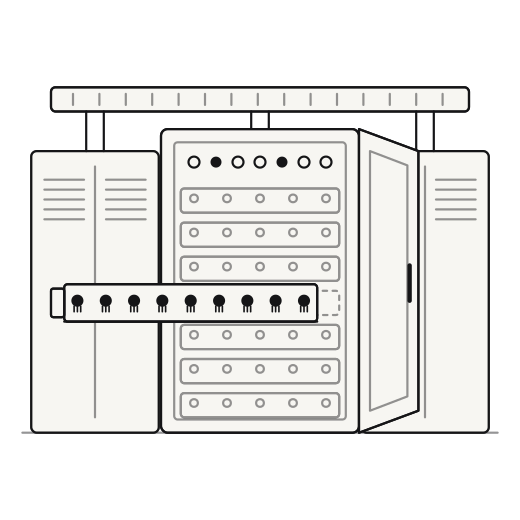
The name stood for Elaboratore Elettronico Aritmetico (electronic arithmetic processor) and was also a tribute to the Greek city of Elea.6 The machine was shown at the Milan Trade Fair in 19596 and on 8 November that year it was inaugurated at Olivetti's Milan offices in via Clerici, in the presence of President Gronchi.1 The first unit went to Marzotto in Valdagno. Between 1960 and 1964 more than thirty were put on the market, bought by Monte dei Paschi di Siena, Fiat, ENI and Lancia among others.3 The design was by Ettore Sottsass, with low cabinets and modules built to human scale that made maintenance easier, and it won the Compasso d'Oro.
It is often described as the first computer in the world built entirely from solid-state components. The Dizionario Biografico degli Italiani rules that out, since others were being built in the United States in the same years, and adds that this takes nothing away from its innovative character.3 It was certainly the first commercial transistor computer produced in Italy.6 In 1961 a smaller model arrived, the Elea 6001, aimed at universities, public bodies and mid-sized industry, which sold around a hundred units.3
One Elea 9003 still exists. Monte dei Paschi used it for payroll, accounts and interest calculations, and in 1972 donated it to the Enrico Fermi technical school in Bibbiena, in the province of Arezzo.7 It is sixteen cabinets about 1.6 metres tall, linked by 40 kilometres of copper cable, in a room of about a hundred square metres, and it still partly works.6
The "blemish to be removed"
After the deaths of Adriano and Tchou, electronics lost its strongest defenders. Roberto Olivetti, Adriano's son, who backed it, did not manage to become chairman. Giuseppe Pero, who did, set up an electronics division in 1962 and died the following year. In 1963 the shares collapsed on the stock exchange and control passed to a rescue group made up of Fiat, Mediobanca, Pirelli and other companies.3
On 30 April 1964, at Fiat's shareholders' meeting, its chairman Vittorio Valletta described Olivetti as a sound company and added: "Over its future, however, hangs a threat, a blemish to be removed" (translated).8 The blemish was electronics. Olivetti obtained a 20 billion lire credit line and the division was sold to General Electric for 8.5 billion, according to Simone Fubini, who had joined that lab in 1956.9 75% went to the Americans in 1964, in the new Olivetti General Electric, and in 1968 the Ivrea company pulled out of that venture too.3
The exception was Pier Giorgio Perotto's Programma 101, considered the first desktop computer. Presented in New York in 1965, it sold about 44,000 units within a few years, 90% of them in the United States.10
The other part of the legacy went to America. Federico Faggin, a physics graduate from Padua, had worked at Olivetti and then at SGS-Fairchild in Agrate, the company set up to supply the Elea with transistors. In 1968 he moved to California, to Fairchild, where he invented silicon-gate MOS technology, and in 1970 he joined Intel.1112 There he led the design of the 4004, the first microprocessor, which in 1971 put 2,300 transistors on a single chip.13
For decades there have been theories that Tchou was murdered, with the blame laid on the American secret services. The Dizionario Biografico degli Italiani calls them "entirely without evidence" (translated).3 The established fact is a road accident. I think the story is bitter enough as it is: losing the Elea took nothing more than a financial crisis and a group of shareholders who saw electronics mainly as a cost.
Sixty-five years later
Today the word in use is sovereignty. On 30 July the EuroHPC Joint Undertaking opened its call for AI Gigafactories, up to seven large computing centres for artificial intelligence in at least seven countries. Bids for the largest centres close on 3 December and those for medium-sized centres on 4 February 2027, after an extension that gives member states time to complete their budget procedures. The choice is expected in 2027.14 According to a summary by the law firm Sullivan & Cromwell, up to 10 billion euros of public money, European and national, is planned, alongside at least 20 billion of private investment. The EU contribution to each centre cannot exceed 17% of the spending on computing infrastructure.15
Italy is having a go. On 11 May the enterprise minister Adolfo Urso announced the bid with Leonardo, Eni and the Fondazione di Torino.16 On 4 October the Corriere della Sera, as reported by Affaritaliani, described talks at Palazzo Chigi with Eni, Enel, Leonardo, Saipem, Snam, Terna, Fibercop and Cdp, and a first phase worth 1.2 billion euros: 200 million from the economy ministry, 200 million from the EU and 800 million from private investors.17 As of 19 October the final make-up of the consortium had not been made public.
Private companies are moving too. Domyn, formerly iGenius, founded in Milan by Uljan Sharka, has raised about 1.1 billion dollars, 90% of it debt according to Sifted, for Colosseum, a supercomputer in southern Italy with around 6,000 Nvidia Grace Blackwell chips. Investors, valuation and the terms of the debt have not been disclosed.18 In France, Mistral presented Mistral Large 4 on 6 October, a model with a trillion parameters, after a round led by Samsung at a valuation of 21 billion euros.19 Mistral too borrowed 830 million dollars from seven banks for its data centre near Paris.18
Underneath all this is research spending. In 2024 Italy invested 1.41% of its gross domestic product in research and development, against an EU average of 2.26% and 3.12% in Germany. Five years earlier it stood at 1.46%.20
Research and development spending as a share of GDP, 2024
What I think
When I hear talk of technological sovereignty I think of the Elea, because that story holds almost everything that is needed and almost everything that can go wrong.
The first lesson is about people. Tchou did not start from a factory or a patent. He had about fifteen young people chosen one by one, the trust of a businessman and the time to build two prototypes before the right one. A gigafactory is a building full of chips. It becomes sovereignty only if Italy has researchers and engineers who use it to build models, products and services, and if they do not have to go to California to do so, as Faggin did.
The second is about money and time. The Elea depended on one man and on the accounts of a private company. When that man died and the figures got worse, nobody had made commitments that went beyond the next financial year. That is why I look closely at how today's projects are funded. Infrastructure paid for largely with debt has to earn money quickly, and haste is the enemy of research. A bid put together in a few months around a call makes sense if public funding is guaranteed for the years it takes to see results, even beyond the life of a government.
The third is the most uncomfortable: do not sell the lab at the first crisis. In 1964 giving up electronics looked like prudence. Seen from today it meant abandoning a field in which Italy had been among the first, and a year later the Programma 101 showed that the right people were still there. Crises always come, and the temptation to raise cash from what does not yet pay is strong. A country that wants to count should decide in advance, with a cool head, which skills are not for sale, as I wrote about who holds the keys to the technology we use.
When the gigafactory projects become public, alongside the number of processors I would look for three things: how many researchers will be hired, on what contracts, and for how many years the funding is guaranteed.